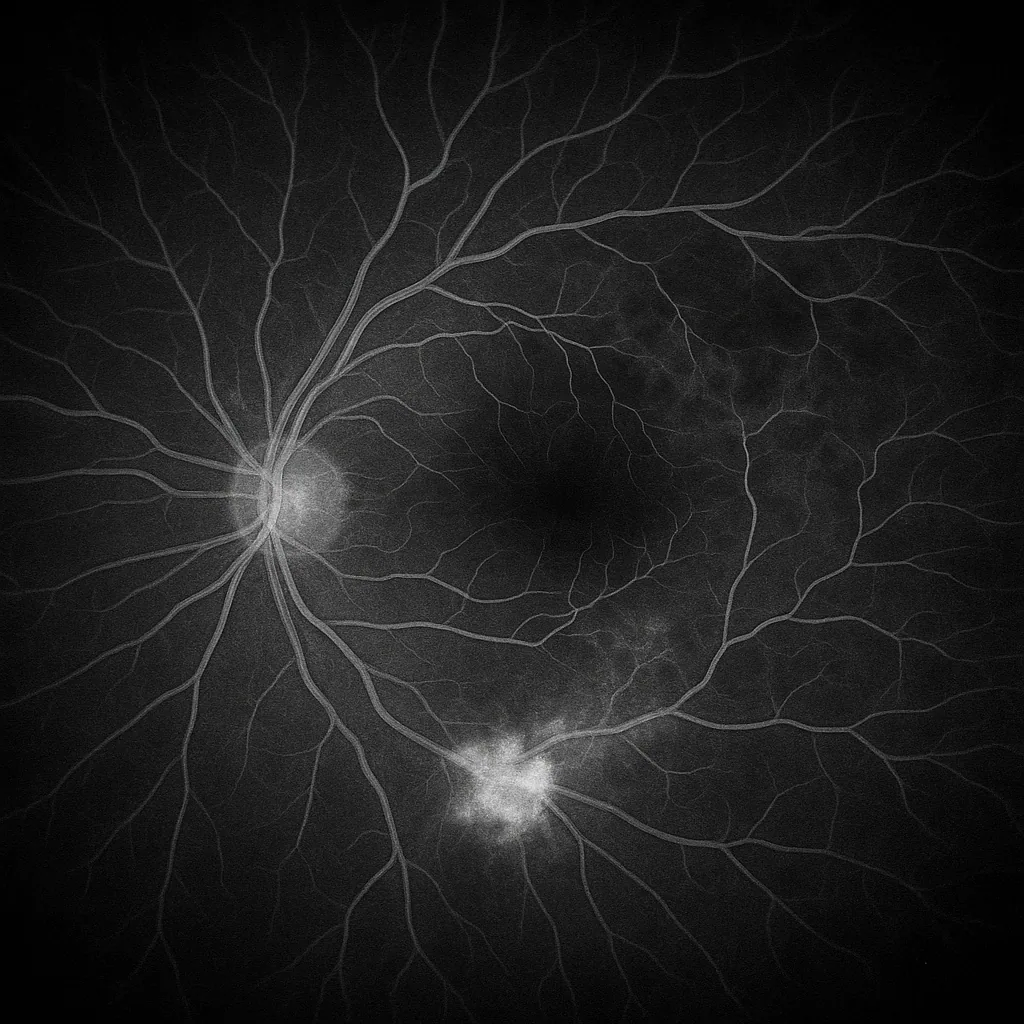

Fluorescein angiography is a retinal imaging examination that allows observation of blood circulation and identification of leaks, hemorrhages, or ischemia. Performed in the office, this examination helps establish a precise diagnosis and guide the treatment of macular conditions such as AMD, or retinal vascular disorders such as CRVO. Dr Julien Gozlan explains its principle, indications, procedure, and risks.
What is fluorescein angiography?
Fluorescein angiography involves injecting a fluorescent dye (sodium fluorescein) intravenously, then photographing the retina using a special camera. The dye, visible under blue light, highlights the course of the vessels and any leaks or poorly perfused areas. Unlike other techniques, fluorescein angiography primarily targets the superficial retinal circulation and perfectly complements examination by macular OCT.
In which cases is fluorescein angiography performed?
This examination is recommended when symptoms or clinical examination suggest a vascular, macular, or peripheral disorder. It is particularly useful for:
- Age-related macular degeneration (AMD): confirms the diagnosis in cases of so-called "classic" choroidal neovascularization.
- Diabetic retinopathy: in advanced cases, it helps determine the stage and guide the timing of treatment.
- Retinal vein occlusions (CRVO or BRVO): confirms the diagnosis and identifies complications (non-perfusion, macular edema, neovascularization).
Often combined with macular OCT, fluorescein angiography clarifies the cause of edema and helps choose the appropriate treatment (injections, laser, surgery).
How is fluorescein angiography performed?
Pre-examination questions and pupil dilation
The examination takes place in the consulting room. After a brief medical history (allergies, pregnancy, previous conditions), the pupils may be dilated using mydriatic eye drops.
Fluorescein injection
Fluorescein is injected into a vein in the arm by a nurse or the physician, in the same way as a blood test.
Image acquisition
The camera captures rapid images at the beginning (early phase), then at wider intervals (intermediate and late phases). Total duration: approximately 10 minutes. A bright light is used; vision may be transiently blurred if the pupils have been dilated.
End of examination and immediate aftercare
The examination is painless; the venipuncture may leave slight sensitivity at the injection site. Afterwards, the skin may turn slightly yellow and the urine yellow-orange for a few hours as the dye is eliminated.
What fluorescein angiography reveals
With fluorescein angiography, the following can be visualized: retinal capillary leakage (edema), microaneurysms, areas of retinal capillary non-perfusion, active retinal neovascularization, classic choroidal neovascularization, and alterations of the retinal pigment epithelium. In AMD, it helps confirm a doubtful diagnosis; in diabetic retinopathy, it guides the timing of retinal laser treatment (panretinal photocoagulation).
Risks and side effects of fluorescein angiography
The most common adverse effects are mild: transient nausea, hot flush, metallic taste. More rarely, urticaria, vasovagal episode, or local extravasation at the puncture site may occur. Severe allergic reactions, such as anaphylactic shock, are exceptional; the team has the necessary equipment available if needed. For practical aspects and precautions in at-risk patients, the recommendations of the French Society of Ophthalmology (SFO) are detailed in the document: "Risks and precautions when using dyes for angiography in ophthalmology".
Inform the physician of any history of drug allergy, asthma, or pregnancy. In the absence of contraindications, fluorescein angiography remains a safe and highly informative examination.
After the examination: interpretation and follow-up care
The fluorescein angiography images are interpreted alongside the OCT and clinical examination to establish a diagnosis and a personalized treatment plan: intravitreal injections, laser photocoagulation, or simple monitoring. The goal is to preserve vision and prevent complications related to retinal diseases.
FAQ: frequently asked questions about fluorescein angiography
Do I need to fast on the day of fluorescein angiography?
In most cases, it is not necessary to be completely fasting for a fluorescein angiography, and it is actually preferable to have eaten a light meal to reduce the risk of vasovagal episode or nausea. However, it is advisable to avoid a very heavy meal just before the examination. If you are being monitored for a particular condition (pregnancy, heart or kidney failure, complex allergies), instructions may be tailored on a case-by-case basis by your ophthalmologist or general practitioner.
Can I drive after fluorescein angiography?
Right after the examination, vision is often blurred for a few hours due to pupil dilation and the bright light used for the photographs. It is therefore preferable not to drive immediately after a fluorescein angiography. Ideally, come accompanied or arrange transportation home, then wait until your vision is comfortable again before getting behind the wheel. Most patients feel comfortable again by the end of the day or the following morning.
Is fluorescein angiography contraindicated in cases of allergy or kidney failure?
A known allergy to fluorescein is an absolute contraindication and must be reported before the examination. In cases of significant allergic history (asthma, anaphylaxis, severe drug allergies), the angiography may still be possible with enhanced precautions, or may be replaced by alternative imaging depending on the situation. Moderate kidney failure is generally not a contraindication, as fluorescein does not use the same elimination mechanisms as certain contrast agents used in CT scans. In all cases, it is essential to mention your medical history (allergies, pregnancy, kidney or heart conditions) so that the approach can be safely adapted.
What is the difference between fluorescein angiography, OCT, and OCT angiography?
Macular OCT provides detailed cross-sectional images of the retina and primarily shows the architecture and thickness of the tissues. OCT angiography (OCT-A) visualizes certain blood flows without dye injection, which is very useful for monitoring. Fluorescein angiography, on the other hand, remains the gold standard for analyzing retinal capillary permeability, leaks, and areas of ischemia. It allows visualization of the dynamic passage of the dye over time, which remains irreplaceable in certain situations (complex forms of AMD, extensive venous occlusions, proliferative diabetic retinopathy, etc.). In practice, these examinations are complementary rather than competing.
How long does discomfort last after fluorescein angiography?
Most patients mainly experience light sensitivity and blurred vision for a few hours due to pupil dilation. The yellowish discoloration of the skin and urine generally disappears within 24 hours, as the dye is eliminated. Nausea, when it occurs, is brief and resolves spontaneously without specific treatment. If more pronounced symptoms appear after the examination (skin rash, persistent malaise, breathing difficulties), you should promptly see a doctor or go to the emergency department to rule out a more significant reaction.
How often should fluorescein angiography be repeated?
There is no standard schedule that applies to everyone. Fluorescein angiography is generally performed at the time of the initial diagnosis, then repeated only if the clinical situation warrants it: worsening vision, changes on OCT, suspected neovascularization, or new areas of ischemia. For routine follow-up, OCT and, if needed, OCT angiography are often sufficient and avoid repeated dye injections. Your ophthalmologist therefore recommends angiography only when the examination is likely to change the management plan (decision regarding injections, laser treatment, or change in therapeutic strategy).
Is fluorescein angiography compatible with pregnancy or breastfeeding?
During pregnancy, fluorescein angiography is generally avoided when another examination (OCT, OCT-A) can provide sufficient information. However, it may be considered on a case-by-case basis when there is a major visual concern, after discussion between the ophthalmologist, the referring physician, and the patient. During breastfeeding, the examination remains possible: as a precaution, it is sometimes recommended to pump and discard breast milk for 24 hours after the injection. In all cases, it is essential to inform the team that you are pregnant or breastfeeding before scheduling the examination.
📍 Fluorescein angiography at the Paris – Auteuil Ophthalmology Practice
Dr Julien Gozlan determines the indication for fluorescein angiography, performs the examination, and interprets the results to establish the most appropriate strategy for your situation (diagnosis, treatment, monitoring schedule).
Book an AppointmentFurther reading
- Macular OCT: the complementary examination of choice for analyzing the central retina.
- Age-related macular degeneration (AMD): when and why to supplement with fluorescein angiography.
- Intravitreal injections (IVT): treatment guided by OCT and retinal imaging.