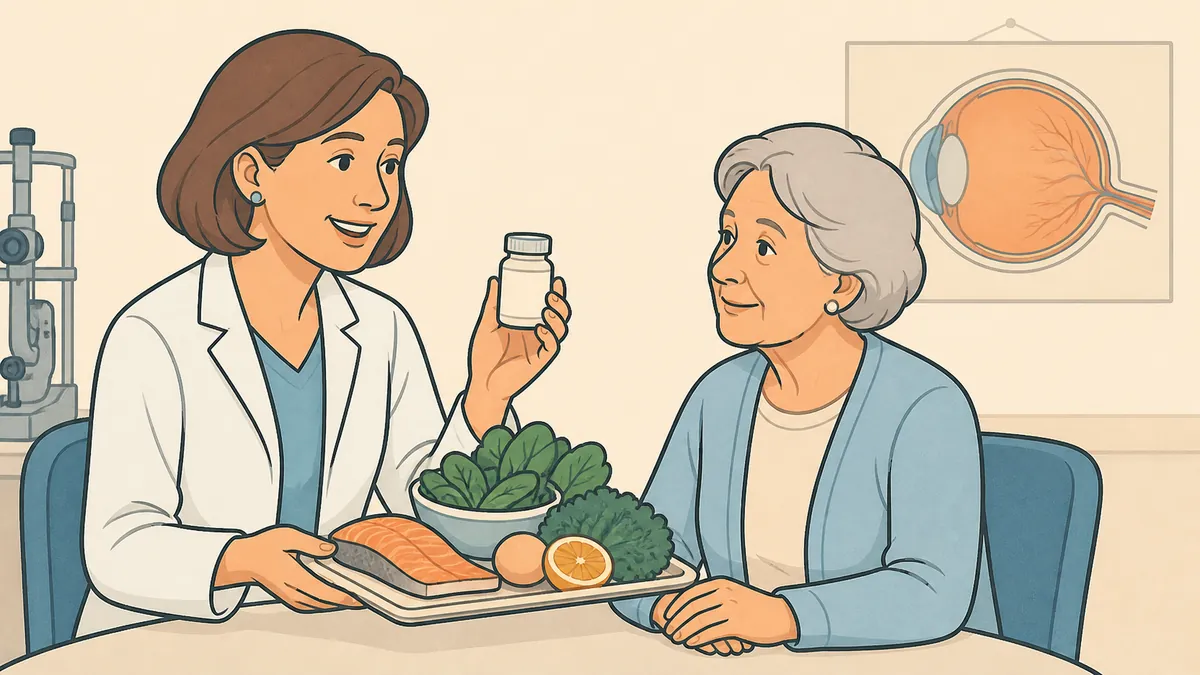

Dietary supplements hold a unique place in the management of AMD: it is the most frequently asked question during consultations. Should you take dietary supplements, which ones, and at what stage? The AREDS and then AREDS2 studies, conducted by the American National Eye Institute, provide precise answers — that are often misunderstood. The formula slows the progression of certain forms of AMD, but it does not prevent the disease. This article takes stock, without exaggerating or downplaying.
Dietary supplements and AMD: what the AREDS and AREDS2 studies show
Two major American studies, AREDS and then AREDS2, conducted by the National Eye Institute, evaluated a combination of vitamins and minerals in thousands of patients with AMD. The primary result, established by the first AREDS study (2001), is robust: in patients with intermediate AMD, or an advanced form in only one eye, the formula reduces the risk of progression to advanced AMD by approximately 25%. AREDS2 (2013) subsequently refined the composition without calling this benefit into question.
This is a real but targeted benefit. The dietary supplements tested do not cure AMD and do not restore lost vision. They slow progression in very specific patients, identified through a fundus examination.
What does the AREDS2 formula contain?
The formula validated by the study combines six components:
- Vitamin C: antioxidant;
- Vitamin E: antioxidant;
- Zinc: at a high dose, always combined with copper;
- Copper: offsets zinc intake to prevent an induced deficiency;
- Lutein and zeaxanthin: two pigments naturally present in the macula.
Compared to the original AREDS formula, beta-carotene was replaced by lutein and zeaxanthin. Most dietary supplements sold in pharmacies for AMD are based on this composition, although dosages sometimes differ from those used in the study.
What dietary supplements do not do
This is the most misunderstood — and most important — nuance. Neither AREDS nor AREDS2 tested dietary supplements in people without AMD: all AREDS2 participants already had large drusen. The absence of a preventive effect of antioxidant vitamins is established by other trials, summarized in a 2017 Cochrane review (76,756 people): vitamin E and beta-carotene neither prevent nor delay the onset of AMD. Specifically:
- No AMD: no demonstrated benefit. Taking dietary supplements "as a precaution" is not supported by any evidence;
- Early AMD: no demonstrated benefit on progression either;
- Intermediate AMD, or advanced AMD in one eye: it is in this situation, and this situation only, that the formula has proven its value.
Supplementation is therefore a treatment aimed at slowing progression, reserved for certain stages. It is not an insurance policy for everyone.
Smokers: why beta-carotene was removed
This point is critical. In smokers, high-dose beta-carotene increases the risk of lung cancer — a finding from the large prevention trials, recalled by the 2017 Cochrane review. In AREDS2, an excess of lung cancers was also observed in the group receiving beta-carotene (2.0% versus 0.9%), mostly in former smokers. This is precisely why AREDS2 replaced it with lutein and zeaxanthin, which do not carry this risk.
If you smoke or have smoked, always check the composition: a formula containing beta-carotene should never be taken in this case. Some older dietary supplements still contain it. If in doubt, bring the box to your consultation.
Are omega-3s effective against AMD?
Omega-3 fatty acids (DHA and EPA) were tested in AREDS2, in addition to the formula. The result is clear: no demonstrated benefit on the progression of AMD. This does not rule out oily fish — regular consumption as part of a balanced diet is still recommended. However, in capsule form, omega-3s have not proven effective for this indication. There is therefore no need to pay more for dietary supplements enriched with omega-3s solely to slow AMD.
Who should take dietary supplements for AMD?
The answer depends on the stage of the disease, determined by fundus examination and OCT:
- Intermediate AMD: the AREDS2 formula is generally recommended;
- Advanced form in one eye: supplementation aims to protect the fellow eye;
- Early AMD or no AMD: no proven indication; monitoring and lifestyle measures take priority.
Your ophthalmologist determines the indication, not the product label. The value of dietary supplements depends entirely on the stage: the same bottle may be beneficial for one patient and pointless for the next.
Diet and smoking: more important than dietary supplements?
Yes, and this must be stated clearly. Two measures carry more weight than any capsule:
- Smoking cessation: smoking is the leading modifiable risk factor for the disease (see causes of AMD);
- Diet: green leafy vegetables (spinach, kale), naturally rich in lutein and zeaxanthin, and regular consumption of oily fish.
Dietary supplements do not replace these measures: they complement them, when the stage warrants it. A patient who continues to smoke while taking supplements is making the wrong trade-off.
Dietary supplements and wet AMD: monitoring remains essential
In cases of wet (exudative) AMD, the standard treatment is anti-VEGF intravitreal injections. Dietary supplements do not treat neovascularization and under no circumstances replace injections. They may be continued to protect the fellow eye, on medical advice.
Monitoring remains essential at all stages: self-monitoring with the Amsler grid, regular examinations, and OCT angiography if necessary. Any new distortion of straight lines or sudden vision loss warrants a consultation without delay.
FAQ: Dietary supplements and AMD
Do dietary supplements prevent AMD?
No. The AREDS studies did not include people without AMD, and the prevention trials (2017 Cochrane review) showed no preventive effect of antioxidant vitamins. The formula slows progression in patients who already have intermediate AMD, or advanced AMD in one eye. In the absence of AMD, taking dietary supplements has no demonstrated indication.
I smoke: can I take a formula for AMD?
Yes, provided it does not contain beta-carotene, which increases the risk of lung cancer in smokers and former smokers. The AREDS2 formula, with lutein and zeaxanthin, was specifically designed to avoid this risk. Check the composition and ask your ophthalmologist for advice.
Which dietary supplements should I choose at the pharmacy?
Look for a composition close to the AREDS2 formula: vitamin C, vitamin E, zinc, copper, lutein, and zeaxanthin — without beta-carotene if you smoke or have smoked. Dosages vary from one product to another. Bring the box to your appointment: the composition will be reviewed with you.
Are omega-3 capsules useful?
No, not for slowing AMD: AREDS2 did not show any benefit of omega-3s on progression. Eating oily fish regularly is still recommended, however, as part of a balanced diet.
Should I talk to my doctor before starting?
Yes, always. High-dose zinc and vitamin E can interact with certain treatments, particularly anticoagulants, or may be inadvisable in certain conditions. Dietary supplements must be approved by your ophthalmologist, in coordination with your general practitioner.
When should you see Dr Julien Gozlan?
Dr Julien Gozlan, ophthalmic surgeon specializing in retinal conditions in Paris 16, offers a comprehensive AMD assessment: fundus examination, OCT, and OCT angiography if necessary. This assessment determines the stage of the disease, and therefore the real benefit of supplementation in your case. If you are already taking dietary supplements, bring the box: the composition will be reviewed with you, particularly if you smoke or have smoked.
📍 Consultation at Cabinet Ophtalmologique Paris - Auteuil
Dr Julien Gozlan welcomes patients at Cabinet Ophtalmologique Paris - Auteuil for an AMD assessment and a prescription tailored to your stage and medical history.
Book an appointmentFurther reading
- AMD: understanding the disease, its dry and wet forms;
- Causes of AMD: age, smoking, heredity — the risk factors;
- Amsler grid: home self-monitoring in just a few seconds;
- Intravitreal injections (IVT): the standard treatment for wet AMD;
- OCT: the key examination for macular monitoring.