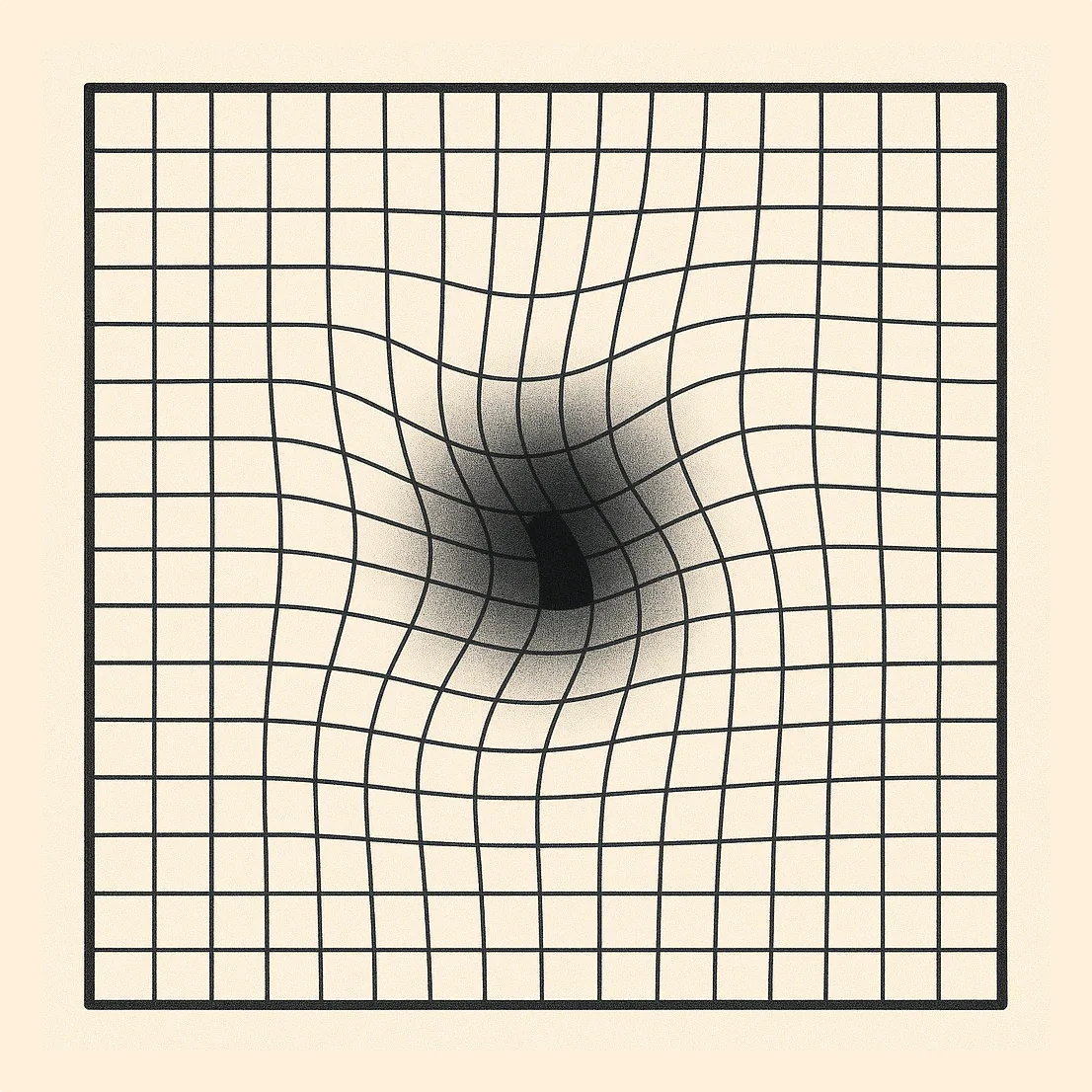

Self-monitoring with the Amsler grid is an essential and simple component of medical follow-up for AMD (Age-Related Macular Degeneration). It enables the earliest possible detection of any change in central vision that may signal a turning point in the disease. Dr Julien Gozlan, ophthalmologist at the Paris – Auteuil Ophthalmology Practice, explains how to perform AMD self-monitoring step by step, from the comfort of your home.
What is self-monitoring with the Amsler grid?
Self-monitoring with the Amsler grid in AMD involves regularly checking—once a week or whenever a new symptom appears—your central vision using an Amsler grid. The purpose of the test is to quickly identify any distortion, dark spot, or decrease in sharpness that may indicate disease progression.
This approach does not replace consultations, but self-monitoring with the Amsler grid strengthens follow-up between appointments by providing you with clear benchmarks to track at home.
Why practice self-monitoring with the Amsler grid?
AMD can sometimes progress rapidly. Early detection of AMD worsening is essential: it allows you to seek prompt medical attention so that a macular OCT can be performed and, if needed, treatment (particularly intravitreal injections) can be started at the right time. Since treatment must be initiated as quickly as possible, self-monitoring with the Amsler grid improves patient responsiveness and helps preserve the retina affected by AMD.
Amsler grid: instructions for AMD self-monitoring
To practice AMD self-monitoring, the Amsler grid is the simplest tool. It consists of a grid pattern with a central dot that must be fixated on during the test. Its sensitivity is nevertheless limited: according to a 2023 meta-analysis, it detects only about two thirds of neovascular forms (sensitivity of 67 to 71%), so a normal grid never exempts you from the scheduled examination.
- Place the grid at 30–40 cm, wearing your reading glasses, in good lighting.
- Cover one eye with your hand, fixate on the central dot while observing the grid without moving your eyes.
- Ask yourself: "Are the lines straight? Are any squares missing? Do you see a gray, blurry, or darkened area?"
- Repeat exactly the same way with the other eye.
- Note the date and keep a record of any abnormalities observed during the test (photo of the grid, small sketch) for future comparison.
Frequency of self-monitoring with the Amsler grid
In practice, perform self-monitoring once a week. If you have a history of the exudative form or recent symptoms, daily monitoring is preferable. Always maintain the same distance, the same corrective lenses, and the same lighting to ensure reliable comparisons.
Warning signs: when to seek urgent consultation?
- Distortion of lines (they appear wavy).
- Dark spot (scotoma) or missing area on the grid.
- Recent decrease in central vision despite wearing your glasses.
If any of these signs appear, consult your ophthalmologist without delay. A clinical examination and macular OCT will be performed to detect any AMD worsening that may require urgent treatment with intravitreal injections.
Practical tips for reliable self-monitoring
- Set a recurring reminder (e.g., every Monday).
- Test one eye at a time, so as not to mask a defect in the other.
- Keep your annotated grids to show the progression to your doctor.
What medical follow-up in addition to self-monitoring with the Amsler grid?
Your ophthalmologist will regularly check the macula through fundus examination and macular OCT, at a frequency adapted to the stage and the treatment: monthly during the initial phase of injection treatment, less often for stable dry AMD. If worsening occurs, treatment with intravitreal injections can be offered promptly. The therapeutic decision remains medical and personalized.
FAQ: frequently asked questions about self-monitoring with the Amsler grid
Can the Amsler grid replace consultations with the ophthalmologist?
No. Self-monitoring with the Amsler grid is a complement to follow-up but never replaces scheduled consultations. Its main purpose is to alert you earlier in the event of an unusual change, so that you can seek medical attention more quickly. Even if the grid appears reassuring — it detects only about two thirds of neovascular forms — in-office examinations (visual acuity, fundus examination, macular OCT) remain essential for monitoring the progression of AMD and adjusting, if necessary, treatment with intravitreal injections.
Can I use an Amsler grid on my phone or only on paper?
Both are possible, but reproducibility is easier with a printed grid. On a screen (phone, tablet, computer), the grid size and brightness can vary, making comparisons over time more difficult. A printed and laminated Amsler grid, always used at the same distance and in the same lighting, provides more stable benchmarks. If you prefer a digital format, try to maintain the same screen settings and the same distance for each test, and note your observations to show your doctor.
What if the lines have always been slightly distorted for me?
Some people already present, even before an AMD diagnosis, slight irregularities (old scar, macular abnormality, longstanding difference between the two eyes, etc.). The important thing is not to have a "perfect" grid, but to detect any change compared to your usual baseline. It is helpful to keep a first grid as a starting reference, then compare each new test to that baseline. If you notice a new missing area, a darker zone, or a more pronounced distortion than before, you should consult without delay.
Should I do the test with or without glasses? What if I wear contact lenses?
The test should be performed under conditions closest to your actual vision. If you use reading glasses, it is preferable to keep them on during the Amsler grid test, so as not to confuse simple poor focus with AMD progression. If you wear contact lenses, self-monitoring is generally done with the lenses in place, provided they are properly fitted and comfortable. If in doubt, you can redo the test with your glasses and discuss it with your ophthalmologist at the next check-up.
What should I do if I forget several weeks of self-monitoring?
This happens frequently and there is no need to feel guilty, but it shows that the test has not yet become part of your routine. The ideal approach is to turn self-monitoring with the Amsler grid into a weekly habit: place the grid somewhere very visible (refrigerator door, bedside table), associate the test with a regular activity (taking medication, weekly television program), or set a reminder on your phone. If you felt that your vision had deteriorated during the period you missed, it is reasonable to request an ophthalmological check-up without waiting for your next scheduled visit.
Is the Amsler grid still useful if my AMD is longstanding or complicated?
Yes. Even in the presence of longstanding or previously treated AMD, the Amsler grid remains valuable for detecting new changes. If you already have a longstanding central spot or a scarred area, the grid is primarily used to detect an expansion of the blurred zone or the appearance of a new distortion. In these complex cases, imaging examinations (OCT, angiography) remain essential, but self-monitoring helps you know when to return earlier than planned if a change occurs.
Can my family members help me with Amsler grid self-monitoring?
Yes, the involvement of loved ones is often very valuable. A family member can regularly remind you to perform the test, note the date and your impressions, keep the annotated grids in a folder, or photograph them to show your doctor. They can also attend a consultation to receive direct explanations about AMD self-monitoring and understand which signs should raise concern. The goal is that you are not alone in facing the disease and that any suspicious change is detected as early as possible.
📍 AMD follow-up at the Paris – Auteuil Ophthalmology Practice
Dr Julien Gozlan offers personalized follow-up: self-monitoring guidance, macular OCT, and treatments when necessary (intravitreal injections) to best preserve your vision.
Book an AppointmentFurther reading
- Age-Related Macular Degeneration (AMD): understanding the forms and symptoms.
- Macular OCT: the reference examination for monitoring AMD.
- Intravitreal injections: procedure, efficacy, follow-up.