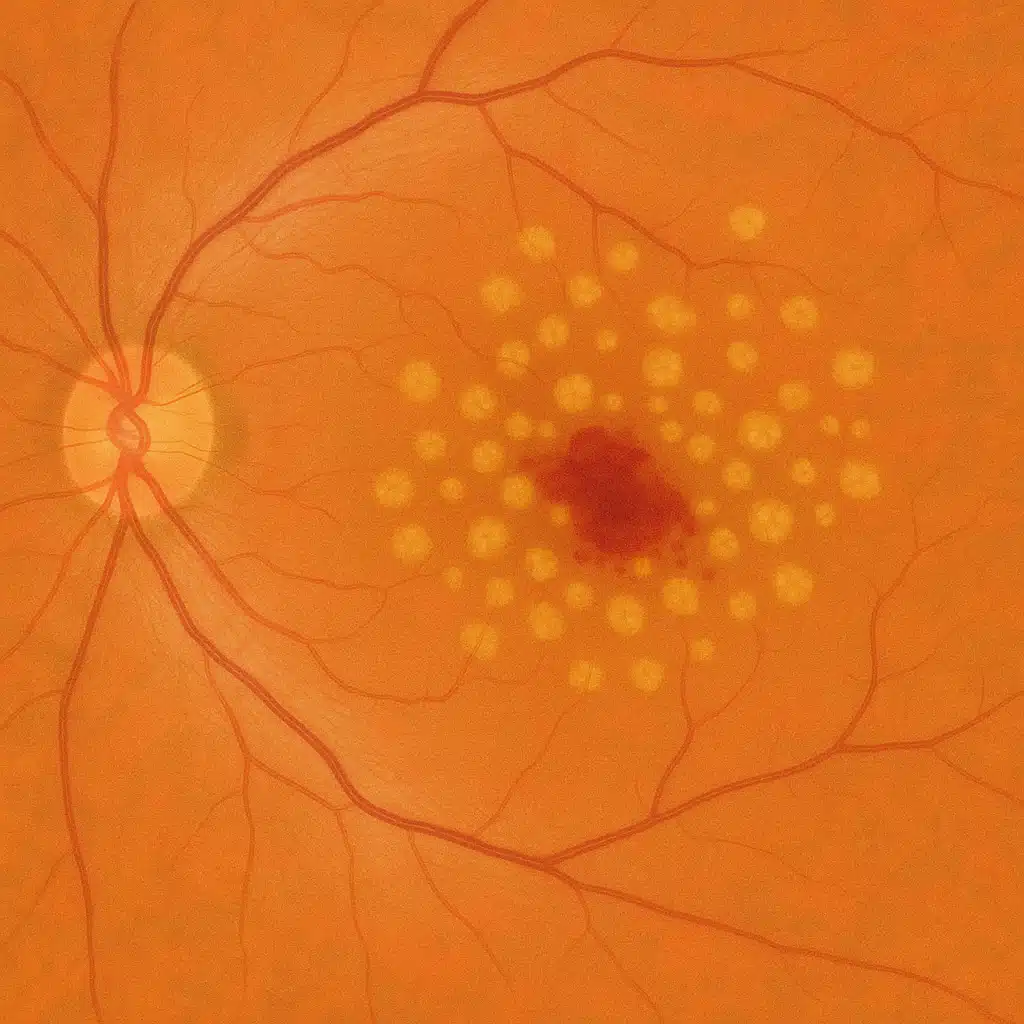

Recognising AMD symptoms (age-related macular degeneration) as early as possible is essential: one of its forms requires prompt treatment. Straight lines that appear wavy, a blurry spot in the centre, difficulty reading… Dr Julien Gozlan, an ophthalmologist and retina specialist in Paris 16, describes the signs that should raise concern and those that progress silently.
AMD symptoms: what you need to know
AMD is a disease of the macula, the central part of the retina. It mainly affects people over the age of 55–60 and always involves the centre of vision, never its periphery. The most common signs are:
- straight lines that appear wavy or distorted;
- a blurry or dark, fixed spot at the centre of the visual field;
- difficulty reading, even with appropriate glasses;
- an increasing need for light to read comfortably;
- difficulty recognising faces or perceiving fine details.
Peripheral vision is generally preserved: you can still move around without difficulty, but fine detail at the centre is lost.
Why are AMD symptoms often absent in the early stages?
This is the most important point to understand: in its early stage, the disease often causes no symptoms at all. Small yellowish deposits called drusen accumulate beneath the macula; they are only visible on fundus examination and retinal OCT. Vision may remain normal or barely affected — this is referred to as age-related maculopathy, not an advanced form. The first AMD symptoms therefore only become apparent later, which makes regular ophthalmological monitoring valuable after the age of 55–60, even when everything seems fine.
Wavy straight lines: the most characteristic sign
Of all AMD symptoms, distortion of straight lines (known as metamorphopsia) is the most telling. Patients describe it in very concrete terms: bathroom tiles that appear warped, door frames that seem to wave, letters that appear to be missing in the middle of a word. This distortion is often noticed by closing one eye and then the other: it may affect only one side. Distortion that has appeared recently is a warning sign: it may indicate a wet form, and it is recommended to seek medical advice promptly.
Dry AMD symptoms: a slow, progressive decline
In the atrophic, or dry form, the macula thins and visual cells gradually disappear. The decline in central vision is slow and progressive: reading becomes increasingly difficult despite appropriate glasses, and a blurry spot may sometimes appear at the centre of the visual field.
No recognised curative treatment currently exists, but management options are available:
- adaptation of lighting and magnifying visual aids;
- low vision rehabilitation;
- correction of risk factors (smoking, blood pressure, cholesterol).
Regular monitoring remains essential, as the condition may progress over time.
Wet AMD symptoms: sudden signs requiring urgent care
In the exudative, or wet form, abnormal blood vessels develop beneath the central retina. Because they are fragile, they leak fluid or blood. Unlike the dry form, wet AMD symptoms come on rapidly:
- new distortion of straight lines;
- a dark spot at the centre of vision;
- the sensation of a central ‘hole’;
- sudden loss of vision in one eye.
This is an ophthalmological emergency: it is recommended to seek care without delay to confirm the diagnosis (fundus examination, OCT, sometimes angiography) and begin treatment. Anti-VEGF intravitreal injections can usually stabilise vision, and sometimes improve it, following a protocol tailored to each patient.
Why do AMD symptoms affect the centre of vision?
The retina lines the back of the eye and acts like the sensor of a camera. At its centre lies a small, highly specialised area called the macula: it is responsible for sharp vision, reading, and recognising faces. AMD corresponds to abnormal ageing of this specific area. This is why its signs affect the centre of your visual field, while peripheral vision is generally spared.
How can you monitor AMD symptoms at home?
Home monitoring relies on a simple approach: regularly testing each eye separately, covering the other, while looking at a text or an Amsler grid. Look for the appearance of wavy lines, missing letters, or a central spot. Should any unusual change occur, it is recommended to seek advice without delay, even if the next check-up is already scheduled.
When should you consult Dr Julien Gozlan about AMD symptoms?
Certain AMD symptoms warrant a prompt consultation:
- a sudden loss of vision in one eye;
- straight lines becoming wavy;
- a dark or blurry, fixed spot at the centre of vision;
- a known macular condition or previously identified possible AMD requiring monitoring.
The in-office examination includes a fundus examination and a retinal OCT, sometimes supplemented by angiography, in order to identify the form involved and begin treatment if necessary.
FAQ: frequently asked questions about AMD symptoms
What are the first AMD symptoms?
Often, there are none: at the early stage, small deposits called drusen accumulate beneath the macula without causing any discomfort, and only a fundus examination and OCT can reveal them. The first noticeable AMD symptoms are difficulty reading despite appropriate glasses, a slight distortion of straight lines, or a blurry patch in the centre. This is why regular check-ups are useful after the age of 55–60, even in the absence of any visual complaint.
Do AMD symptoms affect one eye or both?
AMD generally affects both eyes, but often at different stages. It is not uncommon for only one eye to be affected at the outset, with the other compensating for the loss of vision — which can delay awareness of the condition. This is why a full examination of both eyes is necessary, even when everything seems fine in the unaffected eye.
Does AMD always lead to blindness?
No, almost never completely: peripheral vision is generally preserved. However, the disease can significantly reduce central vision — the vision used for reading, recognising faces, or driving. The goal of monitoring and treatment is to slow progression and preserve functional central vision for as long as possible.
How often should you have a check-up?
This depends on the stage and form of the disease. In cases of simple drusen without any discomfort, an annual consultation may be sufficient, unless a new symptom appears. In cases of confirmed AMD, follow-up is more frequent, with regular OCT imaging. After an episode of wet AMD treated with injections, check-ups are often carried out every 1 to 3 months initially, then spaced out according to observed stability.
Can you keep driving with AMD?
This depends on the level of visual acuity and the quality of vision in each eye. Some early or moderate forms remain compatible with regulations, sometimes with appropriate correction. If central vision becomes too severely impaired, driving becomes dangerous and is no longer permitted. The question should be discussed individually with your ophthalmologist over the course of follow-up.
📍 Consultation at Paris – Auteuil Ophthalmology Practice
Dr Julien Gozlan welcomes patients at Paris – Auteuil Ophthalmology Practice for a comprehensive macular assessment, including fundus examination and OCT, if you have AMD symptoms.
Book an AppointmentFurther reading
- The Amsler grid: monitoring your central vision at home.
- Retinal OCT: the examination that analyses the macula layer by layer.
- Intravitreal injections: the treatment for wet AMD.
- Causes and risk factors of the disease.
- AMD and driving: what the regulations say.