The combination of cataract and myopia is very common. Cataracts often appear earlier in myopic individuals, particularly in cases of high myopia. Surgery can improve vision, but the expectations, lens implant calculations, and risks are not exactly the same as for a non-myopic patient. Julien Gozlan, M.D., ophthalmic surgeon in Paris 16, explains the specific features of cataract in myopic patients, the course of the procedure, and the key points to watch for.
Overview: cataract and myopia, two different conditions
Cataract surgery treats the progressive opacification of the crystalline lens, the natural lens located inside the eye. Vision becomes blurry, hazy, dull, sometimes yellowish, with difficulty reading, driving, or tolerating bright light.
Myopia is a defect in the length of the eye: the image is focused in front of the retina. A myopic person sees well up close but poorly at a distance without glasses. When cataract and myopia coexist, the cataract is superimposed on the pre-existing refractive error and can further alter the required correction, sometimes by increasing myopia ("index myopia").
Does cataract appear earlier in myopic patients?
Yes, especially in highly myopic individuals. An elongated eye is more fragile: the crystalline lens sometimes ages earlier, and certain types of cataract (nuclear, posterior subcapsular) are somewhat more frequent.
In significant myopia, progressive visual decline can be observed as early as the fifties, whereas a "standard" cataract often appears later. This underscores the importance of regular ophthalmological follow-up in myopic adults, in order to monitor both cataract and myopia as well as the condition of the retina.
Specific features of surgery in myopic patients
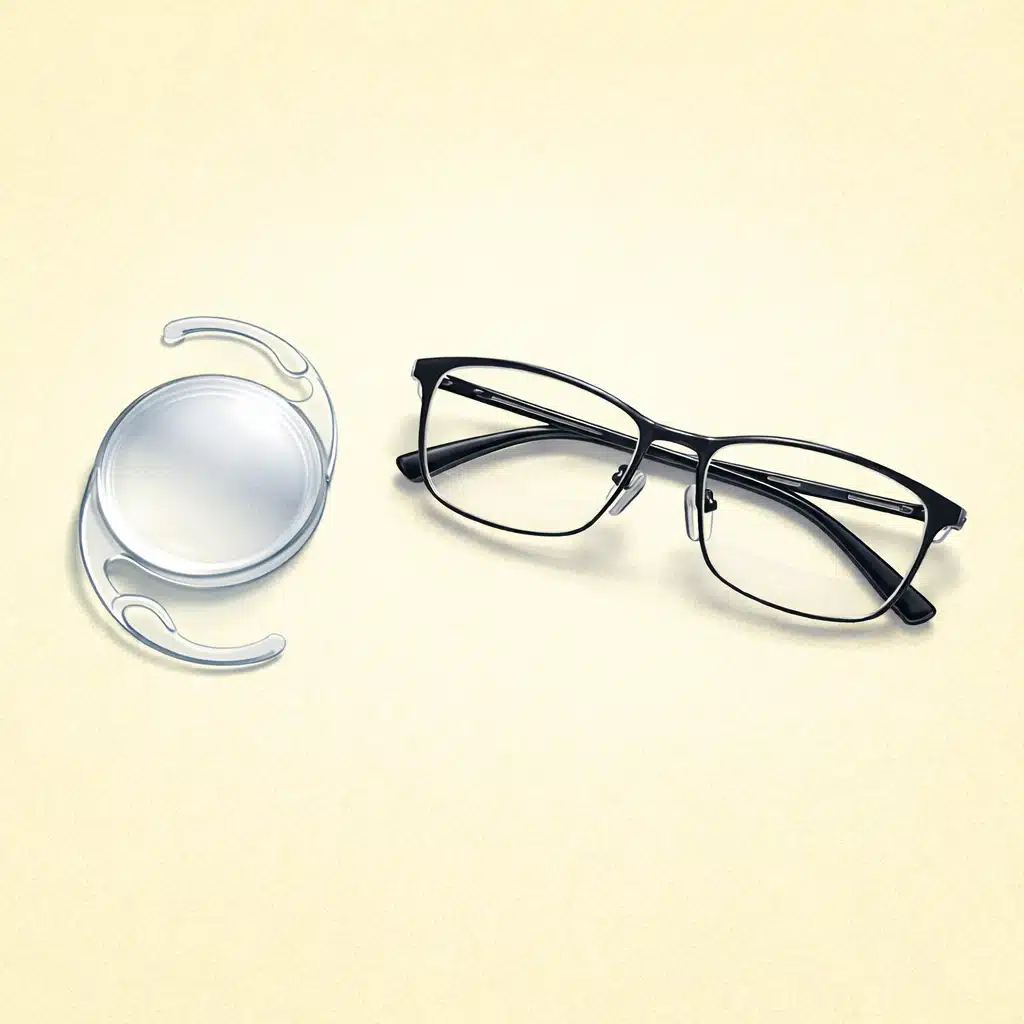
The principle of surgery remains the same: removing the opacified crystalline lens and replacing it with a transparent intraocular lens implant. However, in myopic patients, several points require particular attention:
- biometry (precise measurement of the eye) is more challenging when selecting the implant power;
- the shape of the eye (very long eye, posterior staphyloma) makes calculations more sensitive to small measurement errors;
- the retinal risk (tear, retinal detachment) is slightly higher in highly myopic patients;
- visual expectations (distance vision without glasses, near vision) must be clearly defined in advance.
The refractive plan (with or without glasses after surgery) is discussed on a case-by-case basis: some myopic patients prefer to retain slight residual myopia for reading without correction, while others wish to prioritize distance vision. The challenge is to precisely tailor the surgery to each patient's specific cataract and myopia situation.
Lens implant selection in myopic patients: monofocal, toric, or multifocal?
In myopic patients, a monofocal implant is most commonly used, calculated to optimize either distance or near vision according to the patient's preference. In cases of associated astigmatism, a toric implant can correct part of this distortion and improve visual quality.
Multifocal implants (for seeing both far and near without glasses) should be discussed with caution in highly myopic patients, especially if there are retinal abnormalities. A fragile macula or a history of retinal pathology can limit the benefit of this type of implant and increase halos or nighttime glare. In the context of cataract and high myopia, a simpler and more predictable solution is often preferred.
High myopia and risk of retinal detachment
A highly myopic eye carries a higher risk of retinal tear or retinal detachment, regardless of cataract. Surgery may provide an opportunity to discover peripheral lesions (holes, lattice degeneration) that will need to be monitored or treated.
If warning symptoms occur after the procedure (sudden shower of floaters, light flashes, dark curtain across the vision), an emergency consultation is necessary to rule out retinal detachment. This complication remains rare, but it must be recognized, especially in the context of cataract and high myopia.
Preoperative assessment: a key step for myopic patients
Before surgery, a comprehensive assessment is essential:
- precise measurement of current refraction and visual acuity;
- biometry and corneal analysis, sometimes supplemented by corneal topography;
- fundus examination to evaluate the macula and peripheral retina;
- if needed, additional tests (macular OCT, visual field, etc.).
This assessment helps select the type of implant, estimate the expected final correction, and identify any associated pathologies (peripheral degenerations, epiretinal membranes, etc.). It is particularly strategic when dealing with cataract and myopia, especially in cases of high myopia.
Key points to remember for highly myopic patients
Clinical signs and examinations to monitor
In highly myopic patients, the preoperative examination goes beyond the cataract alone. The specialist analyzes:
- corneal regularity (topography, irregular astigmatism);
- macular quality (macular OCT if in doubt);
- the presence of at-risk peripheral lesions (lattice degeneration, holes, old tears);
- the stability of the refraction over time (progressive or stabilized myopia).
Decision criteria for scheduling surgery
The decision to operate in a cataract and myopia context is based on several criteria:
- functional impact: difficulty driving, working on a screen, playing sports, or reading;
- difficulty in low-light conditions (glare, halos, dulled vision);
- discrepancy between the correction and the vision achieved (feeling that "glasses are no longer adequate");
- stability of biometry measurements and clear discussion of visual goals.
Visual prognosis after surgery
The prognosis is generally good, but depends on:
- the degree of myopia (moderate myopia versus very high myopia);
- the condition of the macula (presence or absence of myopic lesions, atrophy, or membrane);
- the type of implant chosen and the realism of the goals (distance vision, near vision, or a compromise);
- the presence of other associated conditions (glaucoma, diabetes, etc.).
When properly anticipated, cataract surgery in myopic patients provides a real improvement in quality of life, sometimes with a significant reduction in dependence on glasses.
Visual outcomes: what can be expected?
For many myopic patients, cataract surgery provides a very significant improvement in comfort: clearer vision, better contrast, and reduced dependence on glasses (especially for distance).
However, the outcome depends on:
- the initial level of myopia;
- the condition of the retina and macula;
- whether or not significant astigmatism is present;
- and the type of implant chosen.
It is essential to thoroughly discuss visual goals during the consultation (distance vision, near vision, computer use, sports, driving, etc.) to best tailor the strategy in this context of cataract and myopia.
Follow-up after surgery
The postoperative course is generally similar to that of standard cataract surgery: eye drops for several weeks, intraocular pressure monitoring, and progressive visual adaptation.
In highly myopic patients, retinal follow-up remains central, even several years after the procedure, to detect any retinal complication early. Glasses or contact lenses may still be needed to fine-tune distance or near vision, especially if slight residual myopia was intentionally targeted for comfort.
Frequently asked questions about cataract and myopia
Does cataract surgery fully correct my myopia?
The implant can greatly reduce myopia, and even aim for clear distance vision without glasses. However, a small residual correction may remain, especially in cases of high myopia or significant astigmatism.
Is it possible to achieve both distance and near vision without glasses?
This is sometimes possible with certain implants (multifocal, monovision, etc.), but in highly myopic patients, it must be discussed with caution, taking into account the retina, optical quality, and tolerance to nighttime halos.
Does the risk of retinal detachment increase after surgery?
Highly myopic patients are already at greater risk of retinal detachment. Surgery can slightly increase this risk, which is why a retinal examination before and after the procedure, as well as prompt consultation in case of warning symptoms, is important.
Are implant calculations less accurate in myopic patients?
Modern formulas have greatly improved accuracy, but very long eyes remain more sensitive to small measurement errors. It is therefore crucial to have high-quality biometry and a healthy ocular surface.
Can cataract surgery be performed early in a myopic patient?
Yes, if the cataract significantly affects quality of life (driving, work, reading) and the expected benefit is clear. The decision is made on a case-by-case basis, taking into account the myopia and the retina.
Is surgery more complicated in highly myopic patients?
It can be more technically demanding (longer eye, fragile structures), but it remains well-established. The key is to be treated by a surgeon experienced in managing cataracts in myopic patients.
Will I need to change my glasses several times after surgery?
A new prescription is usually given after stabilization (a few weeks). In most cases, a single adjustment is sufficient, unless there are special circumstances (retinal changes, significant residual astigmatism).
Can myopia continue to progress after cataract surgery?
In most cases at the age when cataracts develop, the length of the eye has stabilized. The implant therefore remains stable over time. However, possible retinal changes related to high myopia may affect visual quality.
When to consult Julien Gozlan, M.D.?
You may seek a specialist opinion if:
- you are myopic and your vision is becoming hazy, blurry, or darker;
- you have been told about a cataract but are unsure when to have surgery;
- you are highly myopic and want to understand precisely the risks and benefits of surgery;
- you have already had surgery on one eye and would like a second opinion for the other.
Julien Gozlan, M.D., ophthalmologist in Paris 16, evaluates your situation (myopia, retinal condition, visual impairment) and offers you a personalized surgical plan in this context of cataract and myopia.
📍 Consultation at Paris – Auteuil Ophthalmology Practice
Julien Gozlan, M.D. sees you at the Paris – Auteuil Ophthalmology Practice to review your cataract, your myopia, and the various intraocular lens implant options suited to your lifestyle.
Book an AppointmentFurther reading
- Cataract: symptoms, diagnosis, and treatment
- Cataract implants: understanding the different visual options
- Cataract surgery: course of the procedure, implants, and postoperative care.
- Macular OCT: the reference examination for analyzing the macula in myopic patients.
- Posterior vitreous detachment: floaters, flashes, and warning signs.