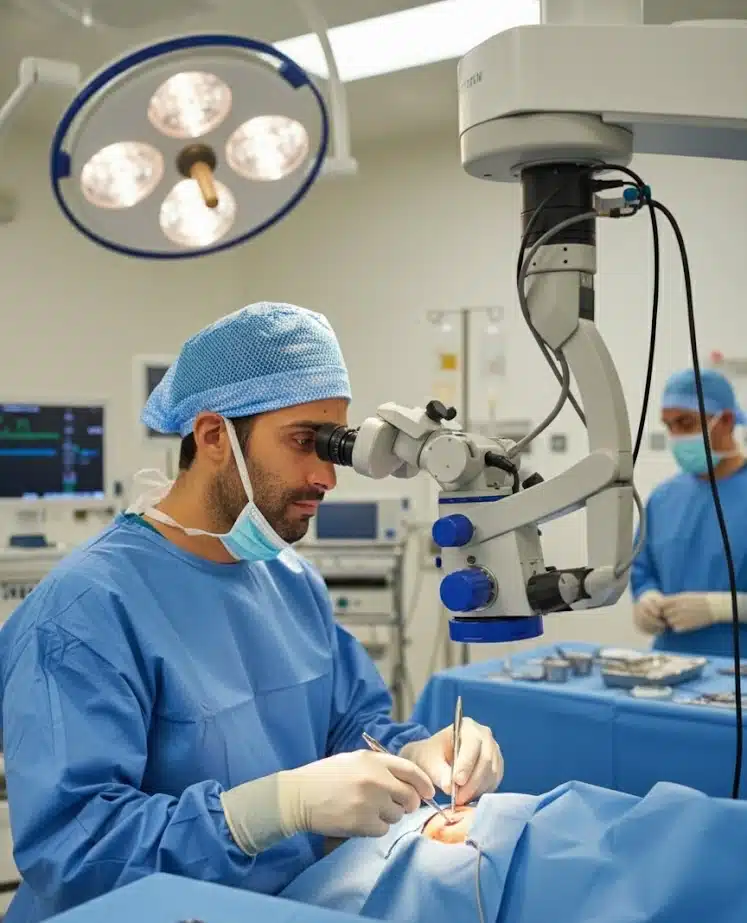

Cataract surgery is today the most commonly performed surgical procedure in ophthalmology. Quick, painless, and extremely safe, it restores clear vision by replacing the clouded natural lens with a transparent intraocular implant. Julien Gozlan, M.D., ophthalmologist in Paris 16, explains the steps of this surgery, the recovery process, and the expected results.
When should surgery be considered?
The decision to operate depends primarily on the impact of the cataract on daily life. When vision loss interferes with reading, driving, or recognizing faces, cataract surgery becomes necessary. It is never an emergency: it is a scheduled procedure, performed when the patient feels the need. To better identify the early signs, you can also visit the page dedicated to cataracts.
A comprehensive eye examination evaluates the transparency of the lens, the condition of the cornea, and the retina. The surgeon also measures the length of the eye to calculate the power of the intraocular implant that will replace the natural lens: this is known as ocular biometry, a key test in the preoperative assessment.
Principle of the surgery
The procedure involves removing the clouded lens and replacing it with a perfectly transparent artificial lens. This technique, called phacoemulsification, uses ultrasound to break up the lens through a micro-incision of less than 2 mm. The fragments are then aspirated, and the implant is inserted into the capsule left in place. For more details on lens options, you can visit the cataract implants page.
Everything is performed under local anesthesia (eye drops or a small injection) on an outpatient basis. The patient goes home the same day, a few hours after the procedure.
Step-by-step surgical procedure
- 1 – Preparation: disinfection, local anesthesia, positioning under the operating microscope.
- 2 – Incision: a micro-opening is made at the edge of the cornea.
- 3 – Lens extraction: the ultrasound handpiece breaks up and aspirates the clouded lens.
- 4 – Implant placement: a foldable lens is inserted and unfolds within the capsule.
- 5 – Closure: the micro-incision seals spontaneously without sutures.
The total duration of the procedure is approximately 10 to 15 minutes per eye.
Postoperative recovery
After cataract surgery, visual recovery is very rapid. Vision clears as early as the next day and continues to improve over the following days. Anti-inflammatory and antibiotic eye drops are prescribed to promote healing.
It is possible to resume normal activities from the next day: walking, watching television, reading… Only swimming and contact sports should be avoided for two weeks. A follow-up visit is scheduled within the days following the procedure, and a second eye can be operated on shortly after if needed.
Intraocular implants
The choice of implant depends on the patient's visual needs. Several options are available, described in more detail on the cataract implants page:
- Monofocal implants: sharp correction for distance vision, requiring glasses for reading.
- Toric implants: also correcting astigmatism.
- Multifocal implants: providing satisfactory vision at all distances without glasses.
Julien Gozlan, M.D. determines the most suitable type of implant based on each patient's expectations and lifestyle. In cases of presbyopia, presbyopia correction at the time of cataract surgery can also be discussed.
In patients with a macular condition such as Age-Related Macular Degeneration (AMD), the surgical indication and implant choice require specific discussion (see also the AMD and cataract surgery page).
Risks and success rate
Cataract surgery is extremely safe: more than 98% of patients achieve improved vision. Complications are rare and most often temporary: inflammation, edema, or mild light sensitivity. Regular follow-up helps prevent and treat them promptly.
In the long term, opacification of the posterior capsule may occur: this is known as "secondary cataract." It is easily treated with a laser procedure in just a few minutes, without further surgery.
Visual outcomes
Patients generally experience a dramatic improvement: clearer vision, more vivid colors, and better contrast perception. Cataract surgery restores a considerable quality of life and often makes it possible to reduce or eliminate the need for glasses for distance vision.
FAQ: frequently asked questions about the cataract surgery procedure
Is cataract surgery painful?
No, cataract surgery is not painful. The eye is numbed locally with drops or a small injection, which eliminates pain throughout the entire procedure. You may feel slight pressure or a sensation of contact, but no actual pain. After the operation, a mild superficial discomfort similar to a small grain of sand is possible for a few hours.
How long does cataract surgery take?
Cataract surgery is a quick procedure: the operation generally lasts between 10 and 15 minutes per eye. However, additional time should be expected on-site for preparation, setup in the operating room, and post-procedure monitoring. The entire process is performed on an outpatient basis, with a return home the same day.
What type of anesthesia is used for cataract surgery?
In the vast majority of cases, cataract surgery is performed under local anesthesia: anesthetic eye drops and sometimes a small injection around the eye. You remain awake but feel no pain. General anesthesia is reserved for certain specific situations (difficulty lying still, associated medical conditions, severe anxiety) and is discussed on a case-by-case basis with the anesthesiologist.
When will I see clearly again after cataract surgery?
Vision often begins to clear as early as the next day after the procedure, but it may remain somewhat blurry for a few days. Most patients notice a marked improvement within one to two weeks, as the cornea and the interior of the eye stabilize. The final visual result is generally assessed between 3 and 4 weeks after cataract surgery.
What precautions should I take after cataract surgery?
After the operation, it is important to follow the prescribed eye drop regimen (antibiotic and anti-inflammatory) and avoid rubbing the eye. Daily activities (walking, reading, screen use) can be resumed very quickly, but it is recommended to avoid swimming, contact sports, and very dusty environments for about two weeks. In case of significant pain, decreased vision, or unusual redness, the surgeon should be contacted promptly.
Can I drive after cataract surgery?
Resuming driving depends on the vision achieved and which eye was operated on. In practice, it is advisable not to drive on the day of surgery or the day immediately after. Driving can then be considered once the vision in the operated eye is stable and overall vision (both eyes) meets the legal driving requirements. Resuming driving is always subject to approval by the ophthalmologist at the postoperative follow-up visit.
What are the main risks of cataract surgery?
Cataract surgery has a very high success rate, but like any surgical procedure, it carries risks: inflammation, edema, transient increase in intraocular pressure, serious eye infection (very rare), or macular edema. Over time, capsular opacification (secondary cataract) may develop and is easily treated with laser. These risks are explained before the procedure and monitored during follow-up.
Should both eyes be operated on the same day?
In France, both eyes are most often operated on a few days or weeks apart. This allows the surgeon to verify the successful recovery of the first eye before scheduling the second. In certain specific situations, bilateral surgery during the same session may be considered, but it remains less common and depends on the surgeon's practice, current guidelines, and each patient's profile.
📍 Consultation at Paris – Auteuil Ophthalmology Practice
Julien Gozlan, M.D. welcomes you at the Paris – Auteuil Ophthalmology Practice for a comprehensive preoperative assessment and personalized support before and after surgery. He performs phacoemulsification with latest-generation implants in a safe and controlled setting.
Book an AppointmentFurther reading
- Cataracts: symptoms, diagnosis, and treatment
- Cataract implants: understanding the different visual options
- Secondary cataract: vision loss after surgery and YAG laser treatment