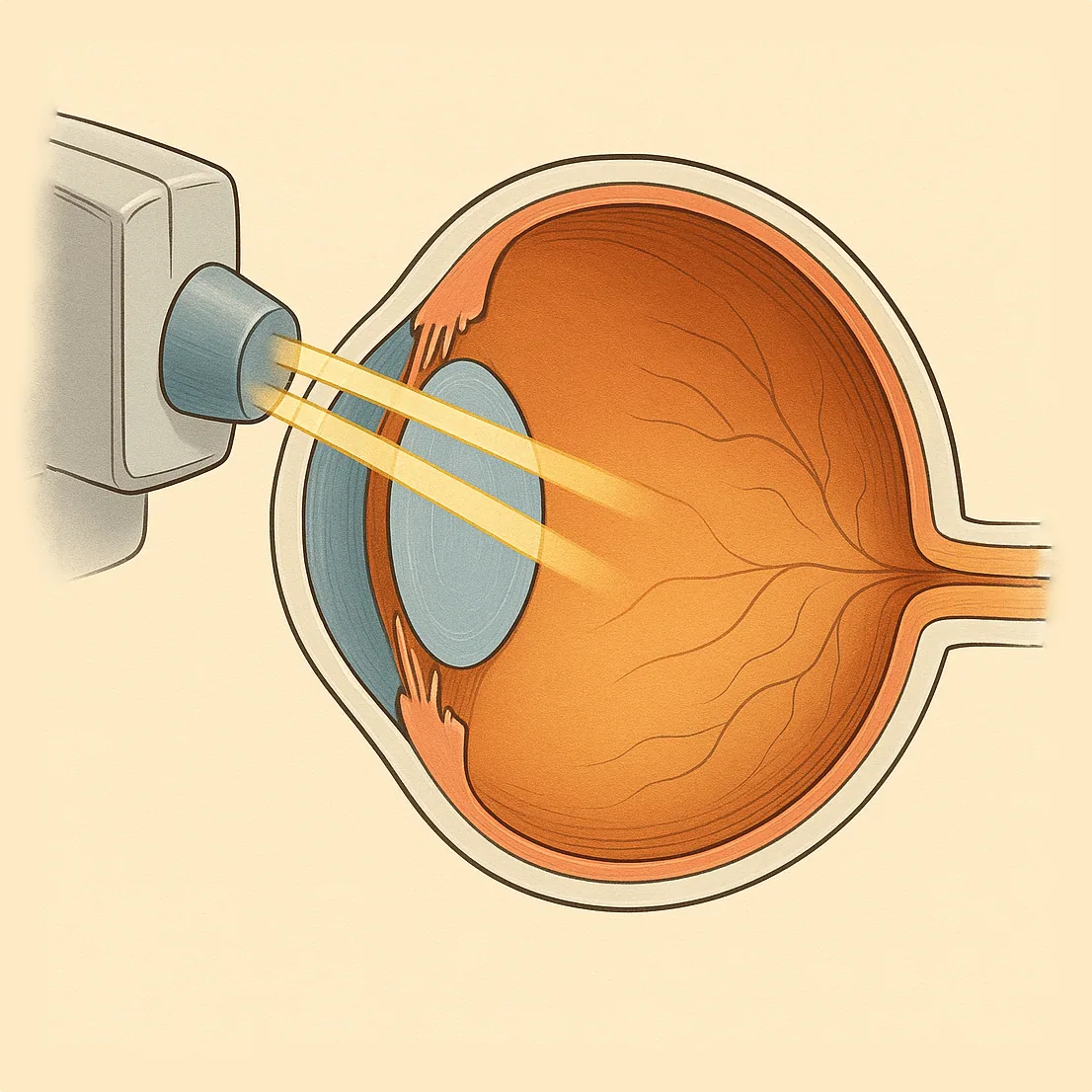
Ocular biometry is the gold standard examination for calculating the power of the intraocular lens implant before cataract surgery. It precisely measures the length and curvature of your eye to optimize the visual outcome. Dr Julien Gozlan explains the principle, the procedure, special cases, and how to obtain reliable measurements.
What is ocular biometry?
Ocular biometry encompasses highly precise anatomical measurements:
- axial length (size of the eye, from the cornea to the retina);
- keratometry (corneal curvature);
- anterior chamber depth and sometimes lens thickness.
These data are integrated into modern calculation formulas to determine the most suitable implant power for your eye, with the goal of achieving the sharpest possible vision after surgery. The examination is non-invasive, quick, and plays a major role, particularly when a "premium" cataract implant is being considered (toric, multifocal, EDOF, etc.).
Why is ocular biometry so important before cataract surgery?
During cataract surgery, the clouded crystalline lens is replaced by a clear implant. The power of this implant directly determines whether or not glasses will be needed after the operation. Precise ocular biometry allows:
- aiming for clear distance vision without glasses (or with minimal correction);
- choosing a possible residual myopia for comfort (reading without glasses);
- adapting the strategy in cases of presbyopia correction through cataract surgery;
- avoiding refractive surprises, especially in patients who have previously undergone refractive surgery.
In practice, good biometry is the foundation of a "tailored" cataract surgery.
How is ocular biometry performed?
Positioning and preliminary refraction
No special preparation is required. The examination is performed in the office on an outpatient basis, without pupil dilation. If you wear contact lenses, remove them at least 24–48 hours before the appointment to avoid biased measurements.
Optical biometer
In the vast majority of cases, the examination is performed using an optical biometer (IOLMaster, Lenstar, and devices from the Zeiss range). You are seated in front of the device with your chin and forehead resting on supports, then you fixate on a target for a few seconds while the device records several series of measurements.
The examination is:
- painless;
- quick (a few minutes per eye);
- generally non-contact with the ocular surface.
Latest-generation devices offer highly reproducible measurements, including in cases of prior refractive surgery (LASIK, PRK).
Ultrasound biometry if needed
If the cataract is very dense or if the optical pathway is compromised (for example, a highly opacified cornea), the biometer's light may no longer properly reach the retina. The assessment is then supplemented with ultrasound biometry, based on ultrasonography.
A small probe then measures the length of the eye. This method remains complementary to optical measurements and helps secure the implant calculation in the most challenging cases.
Calculating IOL power
The collected measurements (axial length, keratometry, anterior chamber depth) are entered into IOL power calculation formulas (Barrett Universal II, Kane, Haigis…). The surgeon then selects the implant best suited to your eye and visual goals, and presents the results at the preoperative consultation.
Advanced parameters influencing biometry
Beyond the displayed values, ocular biometry analyzes several parameters that finely influence the visual outcome:
- type of formula used (Haigis, Barrett, Olsen, etc.) selected according to the eye's axial length and overall anatomy;
- corneal astigmatism index, essential for determining whether or not a toric implant is indicated;
- ratio between axial length and corneal curvature, particularly important in high myopia and small hyperopic eyes;
- kappa angle / alpha angle data in certain cases involving multifocal or EDOF implants;
- consistency between the measurements of both eyes (symmetry, or conversely, asymmetry that needs to be explained).
In patients with retinal disease (for example, early-stage AMD), these parameters are interpreted taking into account the overall visual prognosis in order to select a realistic and comfortable refractive target.
Ocular biometry: proper preparation for reliable measurements
Certain practical details improve the accuracy of ocular biometry:
- temporarily discontinue contact lenses, according to the recommendations provided (a few days for soft lenses, longer for rigid lenses);
- treat any dry eye condition (artificial tears, eyelid hygiene) to stabilize the corneal surface;
- avoid smudging eye makeup or artificial tears just before the examination;
- report any history of LASIK/PRK, trauma, corneal infection, or ocular surface disease;
- blink normally before the measurement is taken, then keep your gaze steady on the target for a few seconds.
This preparation is even more important when the goal is to minimize dependence on glasses as part of presbyopia correction through cataract surgery.
How are ocular biometry measurements used?
The values obtained are integrated into latest-generation calculation formulas. For each eye, the report indicates:
- the targeted refractive outcome (clear distance vision, residual myopia for reading, intermediate compromise, etc.);
- several possible implant powers according to the formulas;
- the final choice discussed with the surgeon based on your expectations.
In the event of discrepancies (poorly reproducible measurements, irregular cornea), the ocular biometry is repeated, possibly cross-referenced with corneal topography or other examinations. A macular check using macular OCT is very often performed alongside to verify the absence of retinal disease that could influence the visual outcome.
Special cases in ocular biometry
Certain situations require specific expertise:
- post-refractive surgery (LASIK/PRK): specific formulas and settings are used, sometimes incorporating previous prescriptions if available;
- irregular cornea or significant astigmatism: ocular biometry is combined with corneal topography to clarify the regularity and axis of the astigmatism;
- very advanced cataract: ultrasound is more frequently used to measure the axial length;
- specific retinal conditions (for example, diabetic retinopathy): the refractive target is adjusted to prioritize long-term visual comfort.
In cases of high myopia or very small eyes, additional adjustments are discussed to minimize the risk of refractive surprise.
Measurement quality: how to optimize accuracy?
The quality of ocular biometry relies on three pillars:
- a healthy ocular surface (corrected dry eye, clear cornea);
- multiple measurement series retained only if they are reproducible;
- expert interpretation that verifies consistency between the eyes and with your ophthalmological history.
When the cataract limits optical accuracy, the surgeon may combine optical and ultrasound biometry, then cross-reference these data with topography and the fundus examination. The goal is to secure the calculation before your cataract surgery, in order to minimize the gap between the expected and actual outcome.
FAQ: frequently asked questions about ocular biometry
Is the ocular biometry examination painful?
No. Ocular biometry is painless and most often non-contact. You simply need to remain still for a few seconds, fixating on the target during measurement acquisition, with no injection or invasive procedure on the eye.
How long does ocular biometry take?
Setup and explanations take a few minutes. The actual measurement process generally takes less than five minutes per eye. When certain series appear less reliable, the practitioner may repeat them to improve the reproducibility of the final result.
Do I need to stop wearing my contact lenses before the examination?
Yes, it is strongly recommended in order not to distort the corneal curvature. The discontinuation period depends on the type of lenses (soft, rigid, orthokeratology) and will be specified when you schedule your appointment. If in doubt, it is better to ask for confirmation rather than arriving with your lenses still in place.
Does ocular biometry guarantee that I will no longer need glasses?
Ocular biometry optimizes the implant power calculation but cannot promise the complete elimination of glasses in every situation. Depending on the chosen goal (clear distance vision, intermediate vision, comfort myopia, multifocal implant), a small residual correction may still be useful for certain distances or activities (fine reading, screen use, night driving, etc.).
Is ocular biometry reliable if I have had LASIK or PRK?
Yes, provided that formulas specific to post-refractive surgery and adapted parameters are used. The surgeon takes your history into account (LASIK, PRK, or other technique) and may cross-reference the biometry with other examinations (topography, correction history) to limit refractive surprises after cataract surgery.
Can biometry be repeated if the measurements seem unusual?
Of course. In cases of doubt (unstable cornea, dry eye, significant asymmetry between the two eyes, poor fixation), the ocular biometry is repeated and compared with other examinations before validating the final calculation. It is sometimes necessary to first treat the ocular surface (artificial tears, contact lens break) and then reschedule the measurements to improve accuracy.
Does pupil dilation need to be performed for biometry?
Not routinely. Most optical biometers work very well without pupil dilation. However, dilation may be offered if other examinations are being performed on the same day (fundus examination, macular evaluation) or if the cataract is very dense and impairs the quality of the optical measurement.
Can ocular biometry results change over time?
Significant variations are rare over a short period, but changes in the cornea (surgery, significant dry eye, keratoconus) or in the cataract may slightly alter the measurements. This is why biometry is, in practice, performed in the months directly preceding surgery, so that the data used for the implant calculation are as recent as possible.
When to consult Dr Julien Gozlan?
You may consult Dr Julien Gozlan if cataract surgery is being considered, if "premium" implants have been discussed with you, or if you wish to gain a more detailed understanding of the possible visual goals after the procedure.
A comprehensive assessment including ocular biometry, macular examination, and consideration of your expectations allows a personalized strategy to be defined and the visual outcome to be optimized.
📍 Consultation at the Paris – Auteuil Ophthalmology Practice
Dr Julien Gozlan performs your ocular biometry, analyzes the results in detail, and confirms with you the most suitable visual target before your surgery. This assessment is part of a comprehensive and personalized care approach.
Book an AppointmentFurther reading
- Cataract implants: an overview of the different implant options available.
- Cataract: symptoms and when to consider surgery.
- Macular OCT: a retinal imaging examination often performed alongside preoperative biometry.