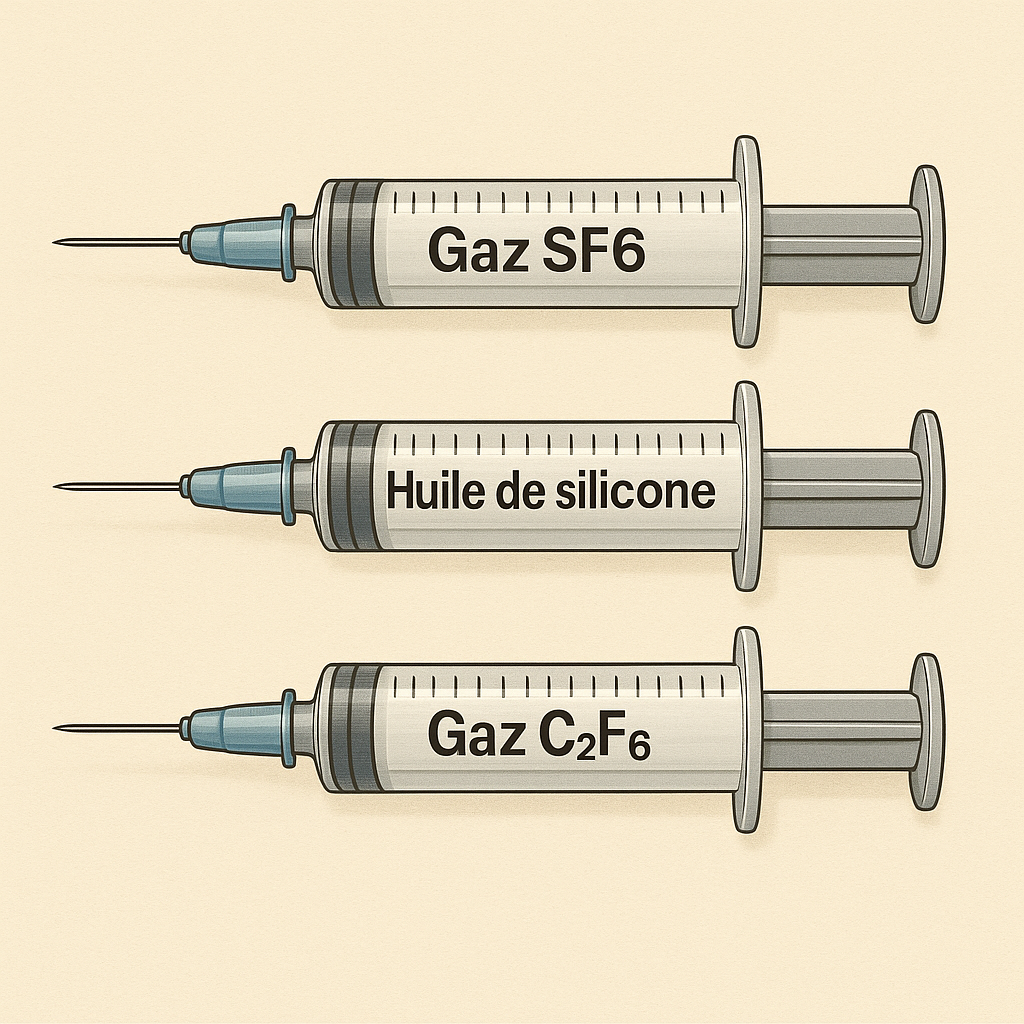

During vitreoretinal surgery, the surgeon may fill the eye with a intraocular tamponade on a temporary or permanent basis. This temporary "filling" of the eye is performed with air, gas, or silicone oil, depending on the situation. Julien Gozlan, M.D., ophthalmic surgeon in Paris 16, details the main types and their indications.
What is an intraocular tamponade?
Intraocular tamponade involves filling the vitreous cavity with a substance that presses against the retina from the inside, acting as an internal cushion. It is not a permanent implant, but rather a temporary support, allowing sufficient time for the laser or cryotherapy to create a solid scar.
This tamponade is placed at the end of a vitrectomy performed for a retinal detachment, a macular hole, a myopic maculopathy, or certain other retinal conditions. Depending on the product used, the duration of action, postoperative instructions, and restrictions (particularly regarding air travel) differ.
Main types of intraocular tamponade
Plain air
Air is the simplest intraocular tamponade. It remains in the eye for a few days and is then rapidly replaced by the naturally produced aqueous humor. It is used for localized detachments or certain small macular holes, when the retina has already been well stabilized by laser treatment.
Expansile gases (SF6, C3F8, etc.)
Expansile gases are widely used for intraocular tamponade. Injected in small volumes, they expand over the following days and then gradually resorb over several weeks. Depending on the type of gas and the concentration chosen, the duration of presence in the eye ranges from approximately 2 to 8 weeks.
They provide prolonged support, particularly useful for retinal detachment surgery or certain complex macular holes. On the other hand, vision remains blurry as long as the bubble is large, and strict restrictions apply regarding air travel or stays at high altitude.
Silicone oil
Silicone oil is a long-duration intraocular tamponade. It does not resorb spontaneously and must be removed during a scheduled second procedure. It is reserved for difficult cases: recurrent detachments, proliferative vitreoretinopathy, complex trauma, severely altered high myopia, etc.
The advantage is that it keeps the retina in place for several months. On the other hand, vision often remains limited as long as the oil is present, and regular follow-up is necessary to monitor intraocular pressure and the condition of the cornea.
In which situations is intraocular tamponade used?
Intraocular tamponade is indicated whenever the retina needs to be pressed against its underlying support after treating tears or fragile areas. The main indications are:
- rhegmatogenous retinal detachment;
- idiopathic or myopic macular hole;
- myopic tractional maculopathy with macular detachment;
- certain forms of diabetic retinopathy;
- ocular trauma with retinal involvement.
The choice between air, gas, or oil depends on the extent of the detachment, the strength of the retinal adhesions achieved during surgery, the patient's condition, and whether or not prolonged support is needed.
Postoperative instructions after intraocular tamponade
After surgery, specific instructions are provided. They depend on the type of intraocular tamponade:
- head positioning: sometimes face-down or on the side so that the bubble presses precisely on the area to be treated;
- relative rest: avoid strenuous activities and contact sports during the healing period;
- air travel and high altitude are prohibited as long as gas is present, due to the risk of a dangerous increase in intraocular pressure;
- regular instillation of antibiotic and anti-inflammatory eye drops.
Vision is initially very blurry, then gradually improves as the air or gas resorbs. With silicone oil, final visual recovery is assessed after its removal.
Risks and monitoring
As with any intraocular procedure, intraocular tamponade carries risks that are rare but possible: elevated intraocular pressure, inflammation, displacement of the bubble, corneal changes, or, more rarely, infection. Close follow-up after surgery enables rapid detection and treatment of these complications.
In the longer term, some patients develop a cataract more rapidly after prolonged tamponade, particularly with gas or oil. This point is discussed before the procedure.
FAQ: vitrectomy and tamponades
What is the purpose of intraocular tamponade after a vitrectomy?
Intraocular tamponade serves to press the retina from the inside during the healing process. After treating a tear or a fragile area (laser, cryotherapy), time is needed for a solid scar to form. Air, gas, or silicone oil then acts as an "internal cushion" that keeps the retina well applied against the eye wall.
What is the difference between air, expansile gas, and silicone oil?
The main difference is the duration of action. Air remains for a few days, expansile gas remains for several weeks (approximately 2 to 8 weeks depending on the type and concentration), and silicone oil remains for several months because it does not resorb and must be removed during a second procedure. The choice depends on the condition, the extent of the lesions, the stability achieved during surgery, and the need for prolonged support.
Why is vision blurry after air or gas tamponade?
As long as the bubble occupies a large portion of the eye, light passes poorly through the vitreous cavity and the image is very blurry. Many patients describe a "water level" that gradually descends: vision improves as the bubble resorbs and is replaced by aqueous humor. With an expansile gas, recovery is often slower than with plain air.
How long does the gas remain in the eye?
The duration depends on the gas used and its concentration. In practice, a gas can persist for several weeks and resorbs gradually. Your surgeon will provide an estimated timeframe tailored to your case and can clinically verify the residual presence of gas during postoperative follow-up.
Why is a specific head position sometimes required?
The bubble (air or gas) naturally rises and presses on the highest part of the eye. Positioning directs this pressure precisely toward the area to be treated (tear, macular hole, localized detachment). Depending on the indication, a face-down position, lying on the side, or avoiding certain positions may be required. These instructions are important because they partly determine the effectiveness of the tamponade.
Can one fly or go to high altitude with an intraocular gas?
No. As long as a gas is present, air travel and stays at high altitude are contraindicated, because the bubble can expand and cause a dangerous increase in intraocular pressure. This restriction does not apply once the air has resorbed, and it differs with silicone oil. If in doubt, always check with your surgeon before traveling.
What are the typical indications for silicone oil?
Silicone oil is generally reserved for situations requiring long-term support: complex or recurrent retinal detachment, PVR (proliferative vitreoretinopathy), severe trauma, significant retinal fragility, or severely altered high myopia. It provides prolonged stabilization, but requires a scheduled secondary removal and monitoring of intraocular pressure and the cornea.
Does tamponade increase the risk of cataract?
Yes, especially after vitrectomy with gas or silicone oil in a phakic patient. A cataract may develop more rapidly in the months that follow. This risk is discussed before the procedure and, if needed, cataract surgery can be considered at a later stage.
What warning signs should prompt an emergency consultation after surgery?
You should seek urgent consultation in case of significant pain, sudden decrease in vision, a dark curtain, marked redness with photophobia, nausea associated with a sensation of a very hard eye (suspected ocular hypertension), or any rapid worsening of symptoms. Close postoperative follow-up is scheduled to check pressure, inflammation, and proper positioning of the retina.
When to consult Julien Gozlan, M.D.?
If vitreoretinal surgery has been recommended for you, if you have a retinal detachment or a macular hole, or if you have questions about the type of intraocular tamponade being considered, a specialist consultation is helpful.
Julien Gozlan, M.D., ophthalmologist in Paris 16, explains in detail the different options (air, gas, silicone oil), their duration of action, associated constraints, and visual recovery outlook in order to choose the most appropriate strategy for your situation.
📍 Consultation at the Paris – Auteuil Ophthalmology Practice
Julien Gozlan, M.D. sees patients at the Paris – Auteuil Ophthalmology Practice for retinal disease assessment and preparation for procedures involving intraocular tamponade (air, gas, or silicone oil).
Book an AppointmentFurther reading
- Vitrectomy: principles of vitreoretinal surgery.
- Retinal detachment: symptoms, emergency, and treatments.
- Macular hole: symptoms, OCT, and management.
- Myopic tractional maculopathy: macular complication of high myopia.