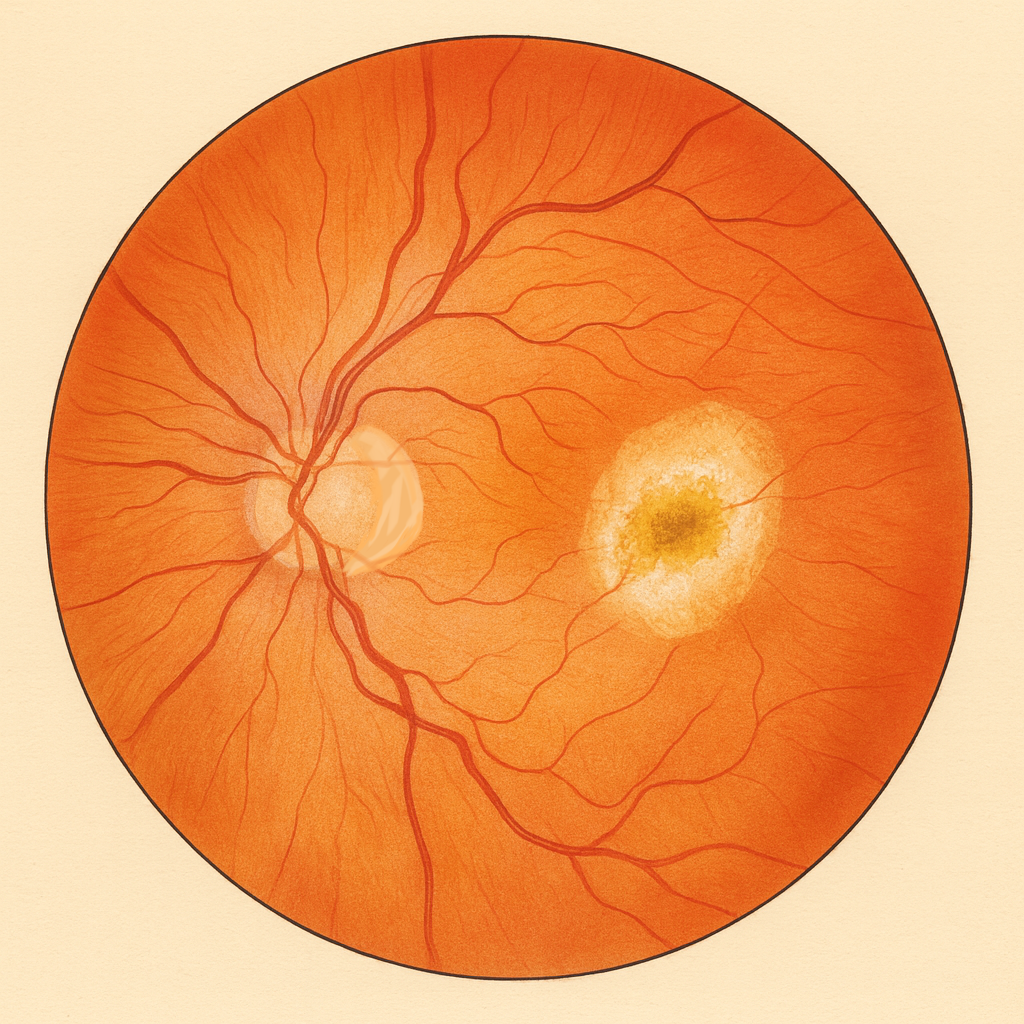

Myopic tractional maculopathy is a complication of high myopia that affects the macula, the central area of the retina responsible for fine vision. It involves vitreous traction, thin membranes, and sometimes a bulging of the posterior eye wall (posterior staphyloma). Julien Gozlan, M.D., ophthalmic surgeon in Paris 16, explains the symptoms, the role of OCT, and the main treatments.
What is myopic tractional maculopathy?
In highly myopic individuals, the eye is longer than normal. The central retina becomes stretched over a curved and thinned wall. Over time, traction exerted by the vitreous, the internal limiting membrane, and thin epiretinal membranes can cause an appearance of "internal splitting" of the retina, known as foveoschisis.
Myopic tractional maculopathy encompasses these various abnormalities: foveoschisis, localized macular detachment, and even macular hole and retinal detachment in advanced forms. OCT allows for very precise visualization of these changes.
Who is affected?
This condition mainly occurs in patients with high myopia (often beyond -6 diopters) or a significantly altered myopic fundus. It generally appears in adulthood, often after age 40–50, when the vitreous begins to change and pull on the macula.
Not all highly myopic patients will develop myopic tractional maculopathy, but the presence of a posterior staphyloma, an epiretinal membrane, or a history of retinal detachment increases the risk.
Symptoms: when should you be concerned?
Symptoms are often progressive:
- decreased central vision in one eye, at distance and/or near;
- distortion of lines (metamorphopsia): sentences appear wavy, tiles look irregular;
- sensation of a small central spot or reduced contrast;
- more rarely, sudden visual loss in case of associated retinal detachment.
Any recent change in vision in a highly myopic patient should prompt a consultation to rule out myopic tractional maculopathy or another macular complication.
How is the diagnosis made?
Fundus examination reveals a stretched macula, sometimes at the bottom of a posterior staphyloma, with folds or small radial striae. The key examination is macular OCT (optical coherence tomography), which provides very fine cross-sections of the retina.
OCT allows visualization of:
- the presence of foveoschisis (intraretinal schisis);
- a localized macular detachment;
- an epiretinal membrane or persistent vitreous traction;
- a possible myopic macular hole.
The workup allows classification of myopic tractional maculopathy and guides treatment decisions.
OCT: what typical signs are found in myopic tractional maculopathy?
Macular OCT not only confirms the diagnosis but also assesses the risk of progression and the potential benefit of treatment. In highly myopic patients, the retina is often very thin, "stretched" over a posterior staphyloma, with internal traction.
- Foveoschisis: separation of retinal layers with columnar intraretinal cavities.
- Persistent vitreomacular traction: vitreous adhesion to the fovea, sometimes localized.
- Epiretinal membrane: appearance of surface folds and superficial thickening.
- Localized macular detachment: subretinal space at the center, often associated with schisis.
- Impending macular hole: foveolar thinning and changes in central architecture.
These findings explain why two patients may have comparable myopia but very different outcomes.
Natural course and complications
In some cases, the condition remains stable for a long time, with moderate visual impairment. In others, traction increases: foveoschisis extends, macular detachment develops, or a macular hole appears. Central vision may then decline more significantly.
Without management, progressive myopic tractional maculopathy can lead to significant loss of central vision and promote a more extensive retinal detachment. This underscores the importance of regular follow-up.
Treatments for myopic tractional maculopathy
Simple monitoring
When visual loss is moderate, the patient is minimally bothered, and OCT shows a stable maculopathy, simple monitoring may be recommended: regular visual acuity checks, comparative OCT scans, and self-monitoring at home (Amsler grid, monocular vision testing).
When should surgery be considered?
Surgery is not systematic. It is considered when myopic tractional maculopathy becomes symptomatic or progressive.
- decreased visual acuity affecting reading or driving;
- increased metamorphopsia (distorted lines);
- worsening on OCT (extension of schisis, appearance of macular detachment, impending macular hole);
- complicated form: myopic macular hole or associated detachment.
Conversely, a stable form with limited symptoms may be closely monitored, as surgery also carries risks (secondary cataract, infections, retinal detachment, etc.).
Vitrectomy with internal limiting membrane peeling
In cases of significant visual impairment or documented worsening, management is most often surgical. The standard technique is micro-incision vitrectomy, combined with internal limiting membrane peeling and removal of tractional membranes.
The goal is to release the traction that sustains myopic tractional maculopathy and allow the retina to reattach. At the end of the procedure, an intraocular gas may be injected to facilitate healing. Visual recovery is gradual over several weeks to several months.
Case-by-case decision
The decision to operate depends on numerous factors: severity of symptoms, occupation, affected eye (only eye or not), precise retinal appearance on OCT, and duration of the lesions. A personalized discussion is essential to weigh the benefit-to-risk ratio.
Prognosis and visual recovery
Visual recovery depends on the duration of traction, the presence of macular detachment, and the condition of the outer retina (particularly the photoreceptor zone) on OCT.
After vitrectomy, the primary goal is to stabilize and gradually improve central vision. Improvement is often slow, over several weeks to several months.
Follow-up and practical advice
After diagnosis or surgery, regular follow-up is essential: vision checks, repeated OCT scans, and fundus examination. At home, it is helpful to test one eye at a time and monitor for the appearance of new distortions or a veil in the visual field, for example using an Amsler grid.
In highly myopic patients, it is also important to seek urgent consultation in case of a sudden shower of floaters, flashing lights, or a dark curtain that may suggest an associated retinal detachment.
Frequently asked questions about myopic tractional maculopathy
Can myopic tractional maculopathy resolve on its own?
Complete spontaneous resolution is rare. Some forms may remain stable for a long time, especially when involving a slowly progressing macular schisis, but the outcome depends on the intensity of traction (epiretinal membrane, vitreomacular adhesions) and the configuration of the myopic eye (posterior staphyloma). OCT is the key examination for assessing stability: appearance or enlargement of schisis cavities, onset of foveolar detachment, or signs of weakening that may precede a macular hole.
Is it the same as AMD?
No. Myopic tractional maculopathy is related to high myopia: elongation of the eyeball, posterior deformation (staphyloma), and traction on the macula causing schisis, foveolar detachment, or macular hole. AMD, on the other hand, is an age-related degeneration with different mechanisms (drusen, atrophy, neovascularization). In practice, OCT generally allows differentiation: myopic traction shows mechanical signs of "pulling," whereas AMD shows alterations of the retinal pigment epithelium and/or neovascularization.
Can this complication be prevented?
It cannot always be prevented, as it partly depends on the anatomy of high myopia. However, the risk of late diagnosis can be reduced by scheduling regular follow-up (fundus examination + OCT) in highly myopic patients, especially in case of visual loss, metamorphopsia, or a history of involvement in the other eye. The goal is to detect a progressive form early and determine the right time to treat (close monitoring versus surgery) before more irreversible damage develops.
Is surgery always effective?
Surgery is often effective in reducing traction and stabilizing macular anatomy, but the visual gain is variable. It most commonly involves vitrectomy with membrane peeling and sometimes internal limiting membrane peeling, with or without tamponade (gas) depending on the case. The best functional outcomes are observed when the procedure is performed before an advanced stage (macular hole, significant macular detachment, prolonged photoreceptor damage). OCT helps estimate the prognosis: integrity of the ellipsoid zone, extent of schisis, presence of foveolar detachment, retinal thickness, and signs of persistent traction.
Is there a risk for the other eye?
Yes, a risk exists because both eyes may share a similar high myopia anatomy (high axial length, staphyloma). This does not mean the other eye will necessarily progress, but it warrants dedicated follow-up, even in the absence of symptoms. In practice, the other eye is monitored with OCT to screen for early schisis, vitreomacular traction, or early signs of a macular hole.
When should you seek urgent consultation?
You should seek prompt consultation in case of a dark curtain, flashing lights, a shower of floaters, or sudden vision loss. These symptoms may indicate a retinal tear or retinal detachment, a more common complication in highly myopic patients that requires urgent management. A rapid worsening of distortion (metamorphopsia) or sudden decrease in central vision should also prompt a timely examination, as it may reflect anatomical progression (foveolar detachment, macular hole).
When should you consult Julien Gozlan, M.D.?
If you are highly myopic and notice decreased vision, line distortion, or if an examination suggests myopic tractional maculopathy, a specialist opinion is recommended.
Julien Gozlan, M.D., ophthalmologist in Paris 16, performs a comprehensive macular assessment (fundus examination, OCT), explains the possible course of the disease, and discusses with you the potential benefit of vitrectomy or simple monitoring.
📍 Consultation at the Paris – Auteuil Ophthalmology Practice
Julien Gozlan, M.D. sees you at the Paris – Auteuil Ophthalmology Practice for the diagnosis and management of myopic tractional maculopathy and other complications of high myopia.
Book an AppointmentFurther reading
- Vitrectomy: principles of vitreoretinal surgery.
- Macular OCT: the gold standard examination for analyzing the macula.
- Macular hole: symptoms and management.
- Association Myopia: information and prevention related to high myopia.