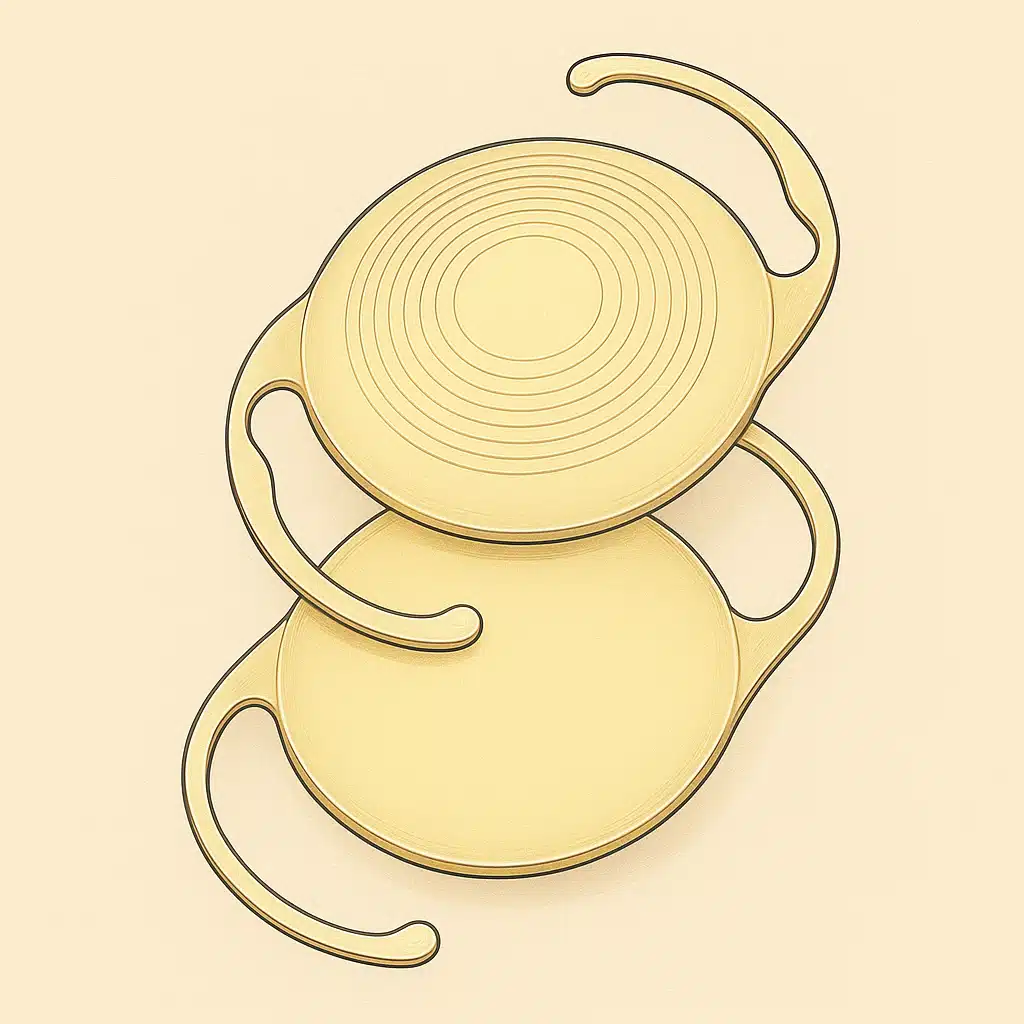

During cataract surgery, an intraocular lens replaces the opacified crystalline lens. Cataract implants are like very thin lenses, custom-calculated to correct your vision. Julien Gozlan, M.D. provides a clear explanation of the different types of implants, how they are chosen, the procedure, and the expected outcomes.
What are cataract implants?
Cataract implants (or IOLs, "intraocular lenses") are placed where the crystalline lens was removed during surgery. Their power is determined through preoperative measurements (ocular biometry) to provide the best possible visual accuracy, often with reduced dependence on glasses.
Types of cataract implants
- Monofocal implant: the gold standard. It provides clear vision at one distance (usually far). Reading glasses are generally still needed for near vision.
- Toric implant: corrects associated astigmatism. It is available in monofocal and advanced versions (EDOF/multifocal depending on the patient profile).
- Multifocal implant: aims for spectacle independence at distance, intermediate, and near vision. Nocturnal halos and a slight reduction in contrast may occur but tend to diminish over time.
- EDOF implant (extended depth of focus): a compromise between monofocal and multifocal. Very good for distance and intermediate vision (computer), but glasses may still be useful for small print.
Depending on the visual goals, surgery can also be an opportunity for complete presbyopia correction, aiming for a balance between distance, intermediate, and near vision.
Cataract implants: how to choose?
The choice of cataract implants is personalized. It depends on your eye (astigmatism, cornea, dryness), your activities (screen use, night driving, prolonged reading), and your expectations (spectacle independence versus maximum visual comfort). A thorough preoperative discussion helps select the best strategy, which may sometimes differ for each eye.
In the presence of significant astigmatism, a toric implant improves sharpness. For patients who read extensively or desire spectacle independence, a multifocal or EDOF implant may be considered after careful evaluation. When the macula is compromised (for example in cases of AMD or other retinal conditions), monofocal implants are often preferred.
Surgical procedure and implant calculation
The surgery is short and painless (local anesthesia in most cases). The opacified crystalline lens is fragmented and then aspirated, and the implant is placed in the capsular bag. The calculation of cataract implants relies on biometry and sometimes corneal topography to refine the result, particularly in cases of astigmatism. A macular assessment using macular OCT also helps adapt the strategy based on the condition of the central retina.
Cataract implants: results, recovery, and glasses
Vision clears within a few days, sometimes more quickly. With a monofocal implant, the goal is usually clear distance vision; reading glasses are then useful. With a multifocal or EDOF implant, spectacle independence is generally greater, especially for daily life and computer use.
A first follow-up visit takes place shortly after surgery (day 1 or day 7 depending on the case), followed by an assessment once stabilization has occurred. The final glasses prescription is considered around 3–4 weeks, once healing and refraction have settled. A brief period of neuro-visual adaptation is normal with advanced implants: the brain learns to utilize multiple focal points. Transient dry eye may blur vision; artificial tears significantly improve comfort.
Possible side effects and safety
Cataract implants are safe and well-established. Halos or nighttime glare may occur with advanced implants (multifocal/EDOF), often diminishing over time. A "secondary capsular opacification" (posterior capsule opacification) may develop months or years after surgery; it is treated in the office in just a few minutes with a YAG laser.
FAQ: frequently asked questions about cataract implants
Can different implants be chosen for each eye?
Yes, in certain situations it is appropriate to combine different implant profiles between the two eyes: for example, a toric implant on one side (to correct astigmatism) and an EDOF or multifocal implant on the other (to extend the range of vision). This choice is always made after a precise optical calculation, a retinal analysis, and a detailed discussion about your habits (reading, night driving, screen work). The goal is to improve overall comfort without creating an imbalance between the two eyes.
What if I drive frequently at night?
For people who often drive at night (daily commutes, night work, long trips), implant profiles offering good contrast and minimizing halos around headlights are generally preferred. Depending on your case, this may lead to recommending a monofocal implant or a carefully selected EDOF implant, possibly combined with light glasses wear for certain activities. The aim is to maintain stable and comfortable night vision, even if this involves a trade-off regarding spectacle independence.
Do cataract implants last a lifetime?
Yes. Modern intraocular implants are designed to remain in place permanently. They are made from stable materials (acrylic, specialized silicone, etc.) that do not degrade over time. It is not the implant that ages, but potentially the posterior capsule that becomes cloudy a few years after the procedure: this is known as "secondary cataract," which is simply treated with a YAG laser without replacing the implant. Implant exchange remains exceptional and is reserved for very specific cases.
Can you feel the implant in your eye on a daily basis?
No. Once healing is complete, you do not feel the implant in your eye. It does not move when you blink or when you sleep on your side. Sensations of discomfort, grittiness, or a foreign body feeling are related to the surface of the eye (dryness, conjunctiva, cornea) and not to the implant itself. In everyday life, you simply have the impression of "seeing differently," without physically sensing the lens.
Can you still wear glasses after an implant is placed?
Yes, and it is actually very common. Depending on the type of implant chosen and the visual plan discussed before surgery, glasses may still be useful for certain distances: fine reading, prolonged screen work, night driving, etc. Surgery does not always aim to completely eliminate glasses, but to significantly improve vision in the situations that matter most to you (leisure, work, daily independence). A slight additional correction is not a failure, but a comfort adjustment.
Can the implant become decentered or shift over time?
In the vast majority of cases, the implant remains perfectly stable within the capsular bag. Rare situations (zonular weakness, ocular trauma, associated conditions) can lead to decentration or tilting of the lens. This may sometimes manifest as reduced visual quality or unusual halos. Regular follow-up allows detection of this type of problem and, if necessary, a recentering procedure or implant exchange can be proposed in very selected cases.
Are cataract implants compatible with MRI examinations?
Yes. Intraocular implants used in routine practice are compatible with imaging examinations (MRI, CT scans, X-rays). They do not contain metallic components that could move or heat up. However, it is advisable to always inform the radiologist that you have had cataract surgery, so that they have a complete medical history and can adapt image interpretation if needed.
📍 Consultation at Paris – Auteuil Ophthalmology Practice
Julien Gozlan, M.D. guides you in choosing your cataract implants (monofocal, toric, EDOF, multifocal) based on your eyes, your activities, and your visual expectations.
Book an AppointmentFurther reading
- Cataract: understanding the condition and the clinical criteria that guide implant selection.
- Cataract surgery: surgical treatment and postoperative course.
- Ocular biometry: preoperative examination that precisely calculates the power of the cataract implant.
- Macular OCT: central retinal analysis required before any ocular surgery.
- Presbyopia correction and cataract: strategies to reduce dependence on glasses.