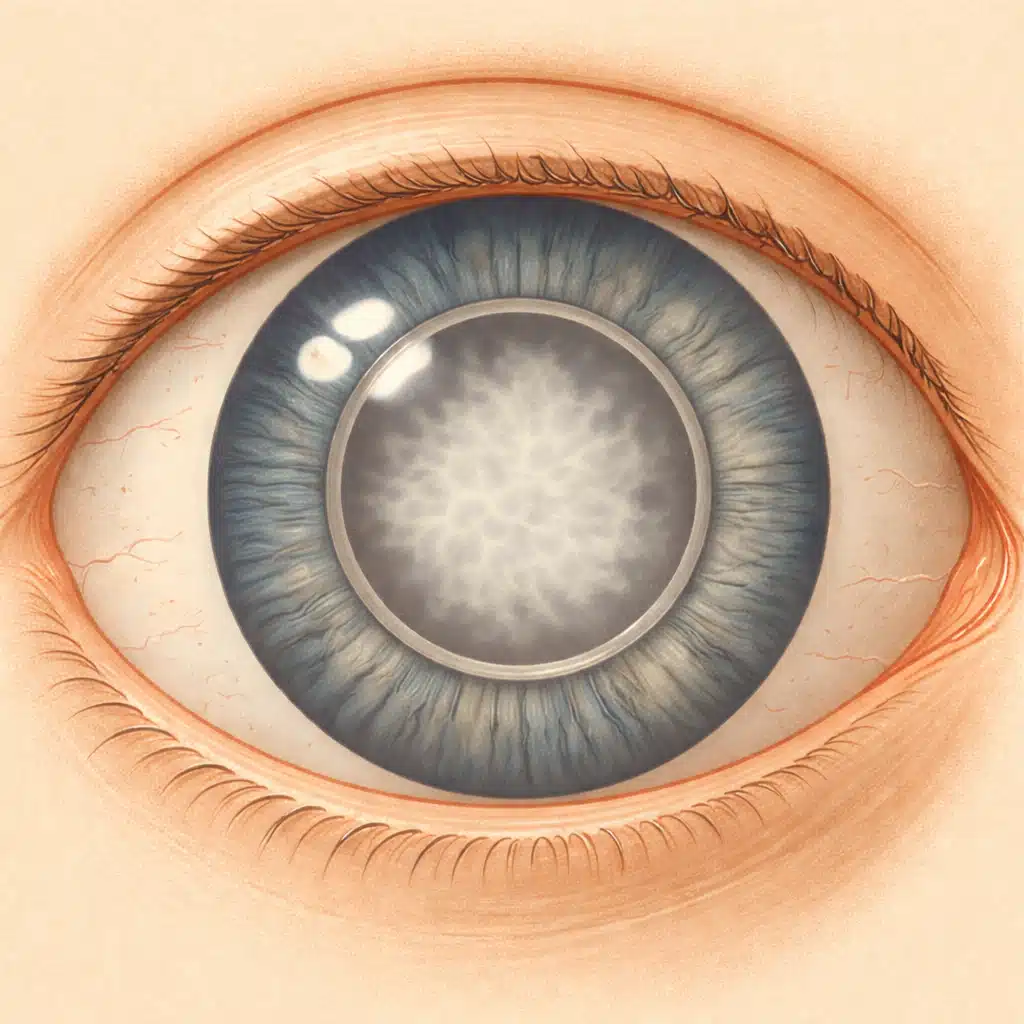

After cataract surgery, vision generally clears up on a lasting basis. A few months or years later, however, some patients notice a new decrease in vision. This is not a "failed operation" but most often a secondary cataract, caused by the gradual opacification of the membrane located behind the implant. Julien Gozlan, M.D., ophthalmic surgeon in Paris 16, explains the symptoms, diagnosis, and treatment with YAG laser.
What is a secondary cataract?
During cataract surgery, the opacified crystalline lens is removed, but its thin envelope, called the capsule, is preserved in order to place the intraocular implant. Over time, residual cells can proliferate on this capsule and gradually make it more opaque: this is a secondary cataract, or posterior capsular opacification.
This condition is common, especially in patients operated on at a young age. It is not serious and can be effectively treated during a consultation through a small opening of the capsule performed with the YAG laser.
Symptoms: when should you suspect a secondary cataract?
A secondary cataract typically presents as a progressive decrease in vision, even though sight had become clear again after the initial operation. Patients often describe:
- a sensation of a veil or blurriness in front of the operated eye;
- increased glare, especially in bright light or while driving at night;
- difficulty with reading or seeing fine details;
- sometimes a loss of contrast or less vivid colors.
These symptoms may be reminiscent of those of the original cataract, but they occur after the crystalline lens has already been replaced by an implant. They warrant an ophthalmological check-up, especially if the discomfort increases over the weeks.
How is the diagnosis confirmed?
The diagnosis of a secondary cataract is based on a comprehensive examination during a consultation. After measuring visual acuity, the physician examines the anterior segment with a slit lamp: opacification of the capsule behind the intraocular implant is observed, sometimes appearing as a "frosted" pattern or in plaques.
When other conditions are suspected (macular involvement, edema, AMD…), imaging such as macular OCT may be performed to verify that the vision loss is not related to a retinal disease.
What does a secondary cataract look like on slit-lamp examination?
Posterior capsular opacification can take different forms, which explains why the level of discomfort varies from one patient to another. The most common findings include:
- diffuse opacification appearing as a veil ("frosted" appearance);
- denser patches centered on the visual axis;
- a so-called "pearly" form (Elschnig pearls) causing fluctuating discomfort depending on the lighting.
In practice, it is primarily the involvement of the central visual axis that determines the decrease in acuity and the indication for treatment.
Secondary cataract: causes and contributing factors
A secondary cataract is caused by the proliferation of residual crystalline lens cells on the posterior capsule. Several factors can influence its occurrence:
- age at the time of surgery (more common in patients operated on at a young age);
- the nature of the initial cataract and the eye's response after surgery;
- the type of cataract implant used and how well it conforms to the capsule;
- certain specific conditions (diabetes, pre-existing ocular inflammation, high myopia, etc.).
Modern cataract implants are designed to limit this phenomenon, but it can still occur, even several years after a technically flawless surgery.
YAG laser capsulotomy: the standard treatment
Principle of YAG laser
YAG laser capsulotomy is a procedure performed during a consultation, without any incision. It involves creating a small circular opening in the center of the opacified capsule, behind the implant. Light can then once again pass freely to the retina, and vision clears up.
The laser acts solely on the capsule, without affecting the cornea, the implant, or the retina. It is not a new cataract surgery but rather a non-invasive complementary procedure.
When should YAG laser treatment be performed?
YAG laser treatment is considered when the secondary cataract becomes bothersome and accounts for the vision loss. The most common criteria include:
- a documented decrease in visual acuity (distance and/or near vision);
- significant functional impairment (reading, driving, glare);
- central opacification visible behind the implant;
- a discrepancy between the optical correction (glasses) and the vision achieved.
Conversely, if the opacification is minimal and vision remains good, simple monitoring may suffice.
How the session is performed
YAG laser capsulotomy is carried out in a few steps:
- instillation of eye drops to dilate the pupil and, in some cases, prevent a rise in intraocular pressure;
- positioning in front of a special lamp, similar to the one used during a routine examination;
- possible placement of a small contact lens on the eye, with gel, to focus the laser;
- application of several YAG laser pulses to open the capsule at the center of the visual field.
The procedure is painless, but the patient may hear small clicking sounds and see flashes of light during the delivery of the pulses.
Recovery and visual improvement
After the procedure, vision may be blurry for a few hours due to dilation and micro-particles in the vitreous. Most patients notice a rapid improvement in clarity within the hours that follow, with better perception of contrast and details.
A follow-up check may be carried out within the hours or days following the capsulotomy. Anti-inflammatory eye drops are sometimes prescribed for a few days. The result is generally long-lasting: once opened, the capsule does not close again.
Risks and possible complications
YAG laser capsulotomy is a safe and highly practical procedure. As with any medical procedure, however, it carries risks that are rare but possible:
- transient elevation of intraocular pressure;
- mild discomfort or temporary eye irritation;
- very rarely, intraocular inflammation or displacement of the implant;
- exceptionally, retinal detachment or macular edema in at-risk patients.
These events remain rare given the number of capsulotomies performed each year. A thorough patient history and careful examination allow the benefit-risk ratio to be assessed in each case.
Practical advice after YAG laser treatment
After treatment of a secondary cataract with YAG laser, a few simple recommendations are helpful:
- follow the prescribed eye drop regimen, if applicable;
- avoid rubbing the eye excessively on the day of the session;
- seek emergency consultation in the event of significant pain, sudden vision loss, or the appearance of a dark curtain;
- plan, if needed, to have your glasses updated a few weeks later if the prescription needs to be adjusted.
For patients with AMD, diabetes, or other ocular conditions, ongoing follow-up remains essential after treatment of a secondary cataract.
FAQ: YAG laser and secondary cataract
Can a cataract "come back" multiple times?
No. The original cataract does not come back because the crystalline lens has been removed. A secondary cataract refers to the opacification of the capsule located behind the implant. Once this capsule has been sufficiently opened with the YAG laser, the opacification generally does not reform. In rare cases, a small additional treatment may be necessary if the initial opening was intentionally limited or if an area remains bothersome along the visual axis.
Is YAG laser painful?
No. The procedure is performed using eye drops and does not require general anesthesia. You may feel slight discomfort from the contact lens (if used) and the light, sometimes a sensation of small "clicks" from the laser, but there is no real pain. If significant sensitivity occurs, it should be reported immediately so that the procedure can be adjusted.
How long does the session last?
The session is quick. The laser itself often takes only a few minutes. However, you should allow a little more time at the practice for the instillation of eye drops (dilation and/or inflammation prevention), checking the eye after the procedure, and, depending on the case, monitoring intraocular pressure.
Can you drive after the session?
Since the pupil is often dilated, vision may be blurry and sensitive to glare for a few hours. It is therefore preferable not to drive immediately after the laser and to arrange for an accompanied return home if possible. Most patients resume their usual activities the next day, depending on the quality of their vision and the instructions provided.
When will the vision improvement be noticeable?
The improvement is often rapid: within a few hours to a few days. Temporary blurred vision may occur right after the procedure, especially if the pupil is dilated or if some capsular debris remains in suspension. If the vision loss persists or is accompanied by pain, you should contact the practice.
Is there a risk of retinal detachment?
The risk is rare, but it does exist, especially in patients who are highly myopic or who have already had a retinal detachment. This is why an appropriate examination and follow-up are important. After YAG laser treatment, the appearance of flashes, a shower of floaters, or a dark curtain should prompt you to seek prompt medical attention.
Does the procedure need to be repeated?
In the vast majority of cases, a single capsulotomy is sufficient. Rarely, some patients may require an additional treatment if the initial opening was intentionally limited (as a precaution) or if an opacified area still interferes with the visual axis. In most cases, if the opening is well-centered and sufficiently wide, the result is long-lasting.
Does YAG laser affect the implant?
No. The laser acts on the capsule located behind the implant, not on the implant itself. The implant is not changed, and this is not a new intraocular surgery in the sense that the eye is not reopened. The goal is simply to recreate a transparent "window" in the capsule to allow light to pass through.
When should you consult Julien Gozlan, M.D.?
If you notice a decrease in vision, a sensation of a veil, or glare that reappears after cataract surgery, a consultation is recommended to confirm a secondary cataract and to rule out another cause.
Julien Gozlan, M.D., ophthalmologist in Paris 16, performs the examination, explains the origin of the discomfort, and discusses with you the indication for YAG laser treatment.
📍 Consultation at Paris – Auteuil Ophthalmology Practice
Julien Gozlan, M.D. welcomes you at the Paris – Auteuil Ophthalmology Practice to assess vision loss after cataract surgery, confirm or rule out a secondary cataract, and perform a YAG laser capsulotomy if indicated.
Book an AppointmentFurther reading
- Cataract: understanding the initial condition whose treatment may be followed by secondary opacification.
- Cataract surgery: how the procedure is performed, implants, and postoperative recovery.
- Cataract implants: types of implants and vision correction.
- Macular OCT: useful when another retinal cause is suspected.
- Retinal detachment: emergency symptoms and management.