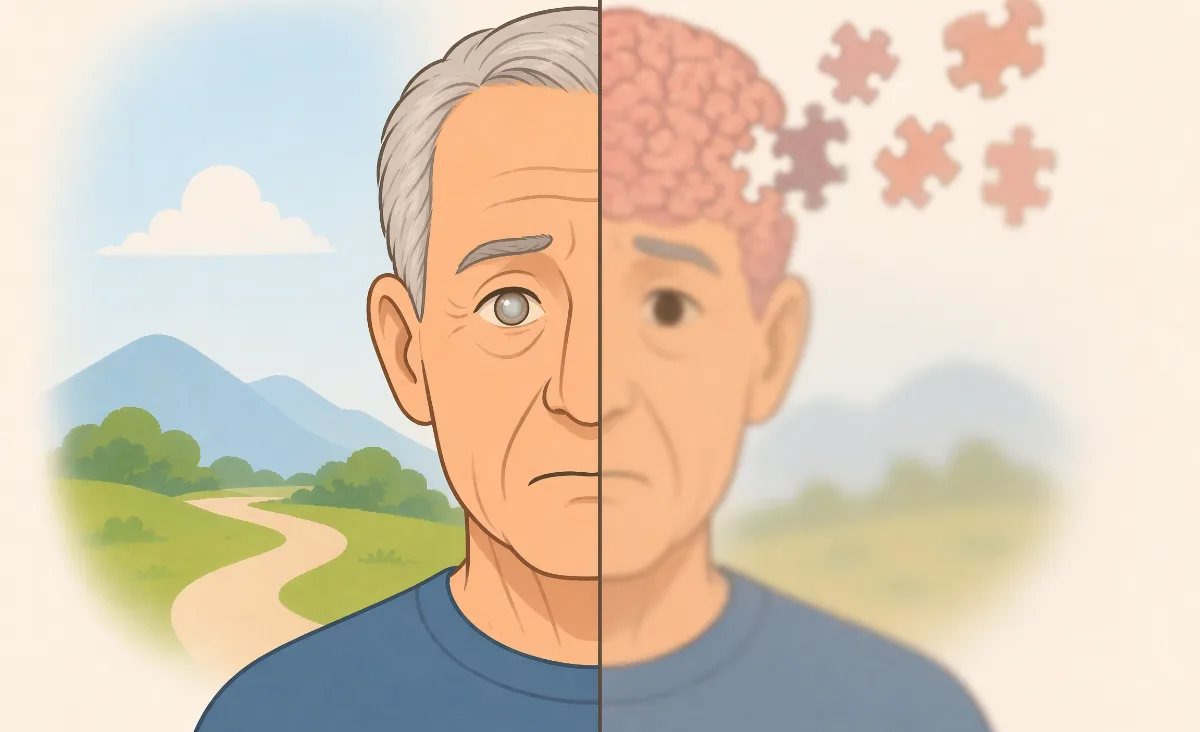
Dementia is one of the major concerns associated with aging, and recent scientific studies observe an association between unoperated cataract and the acceleration of cognitive decline. Cataract and dementia are now two inseparable health challenges for the elderly. In this article, you will discover how vision loss related to cataract contributes to dementia, what scientific evidence links vision and Alzheimer's disease, and why cataract surgery may help slow cognitive decline. Dr Julien Gozlan, ophthalmologist in Paris 16, explains the mechanisms at play and the importance of early management.
Dementia and cataract: what do scientific studies say?
The relationship between cataract and dementia has been highlighted by several large-scale studies. A study published in late 2021 in JAMA Internal Medicine, involving more than 3,000 participants from the Adult Changes in Thought (ACT) cohort, observed that patients who had undergone cataract surgery had a risk of developing dementia reduced by nearly 30% compared to those who had not been operated on — an association, not proof of causation: the authors themselves call for this finding to be confirmed by further studies. This result, confirmed by other epidemiological studies conducted in Europe and Asia, suggests that restoring vision does not only improve visual comfort but exerts a measurable protective effect on brain function.
A meta-analysis of 14 prospective cohorts published in Ophthalmology (2021) also identified visual impairment as a risk factor for dementia. The Lancet commission on dementia prevention, which did not include vision among its 12 factors in 2020, added untreated vision loss — of which cataract is the leading cause in the elderly — to its list of 14 modifiable factors in 2024. These data reinforce the idea that treating cataract is not merely an ophthalmological procedure: it is also, potentially, a preventive measure.
How cataract accelerates cognitive decline and promotes dementia
The human brain devotes a considerable portion of its resources to processing visual information. When cataract progressively reduces the quality of vision, several deleterious mechanisms set in and promote the onset or worsening of dementia:
- Reduction of active cognitive load: blurred vision decreases the quantity and quality of sensory stimulation received by the brain. Reading, face recognition, visual exploration of the environment — all activities that maintain neural circuits — become difficult or even impossible. The brain, less stimulated, progressively weakens.
- Social isolation: patients with advanced cataract tend to reduce their social interactions. They participate less in conversations, give up outings and group activities. Yet social isolation is a major and independent risk factor for dementia.
- Sedentary lifestyle and loss of independence: the fear of falling, difficulty moving around safely, and the inability to drive lead to a drastic reduction in physical activity, which is itself correlated with the progression of cognitive decline toward dementia.
- Depression and anxiety: vision loss undermines self-esteem and quality of life. Depression, which is common among visually impaired patients, is a recognized aggravating factor for Alzheimer's disease and other forms of dementia.
Thus, untreated cataract triggers a vicious cycle: less vision leads to less stimulation, fewer interactions, and less movement, which accelerates the deterioration of cognitive functions and significantly increases the risk of dementia.
Operating on cataract to protect the brain: what the studies suggest
Cataract surgery by phacoemulsification, as performed by Dr Julien Gozlan, is today the most commonly performed surgical procedure in the world. It consists of removing the opacified crystalline lens and replacing it with an intraocular implant. The procedure, performed on an outpatient basis under local anesthesia, takes an average of 15 to 20 minutes and provides rapid visual recovery.
The results of studies on the link between this surgery and dementia are particularly encouraging. The ACT study suggests that the cognitive benefit associated with cataract surgery may be specific: it was not found for other ocular surgeries such as glaucoma surgery, which supports an association between visual restoration and brain protection against dementia — without establishing the mechanism.
By restoring clear vision, surgery allows:
- Reactivation of visual neural circuits: the occipital cortex once again receives high-quality information, which stimulates all associated cognitive networks and slows cognitive decline.
- Resumption of intellectual activities: reading, board games, screen use — all protective activities against dementia that become accessible again.
- Restoration of social connections: recognizing faces, participating in conversations, and going out with confidence considerably reduces isolation, a major factor in dementia.
- Reduction of fall risk: better vision promotes the maintenance of physical activity, a recognized protective factor against dementia.
Preoperative assessment and ophthalmological follow-up: a key role
Before any procedure, Dr Julien Gozlan performs a complete assessment including high-precision ocular biometry to determine the implant power, as well as a fundus examination and OCT (optical coherence tomography) to check the condition of the retina. In elderly patients, it is essential to ensure that the retina — and in particular the macula — is in good condition to guarantee optimal visual benefit after the operation.
This assessment is all the more important as certain retinal conditions such as AMD (age-related macular degeneration) frequently coexist with cataract in elderly individuals. Dr Julien Gozlan can thus propose comprehensive management, combining cataract surgery and retinal treatment if necessary, to maximize visual recovery and, by extension, the benefit on dementia prevention.
Practical advice: do not delay treatment
Too often, cataract surgery is postponed by patients or their families, who consider it a "comfort" procedure. Current scientific data call for reconsideration of this approach. By delaying surgery, the brain is deprived of essential visual stimulation, and the patient is exposed to an increased risk of potentially irreversible dementia.
Warning signs that should prompt a prompt consultation:
- Persistent blurred or hazy vision
- Difficulty reading, even with appropriate glasses
- Increased glare, particularly when driving at night
- Altered color perception (yellowing)
- Progressive loss of independence in daily activities
- Withdrawal or tendency toward isolation in an elderly relative
In a patient showing signs of early dementia and significant cataract, surgery should be considered without delay, in consultation with the primary care physician and geriatrician.
FAQ: Cataract and dementia
Can cataract surgery truly reduce the risk of dementia?
Several large-scale studies have observed that cataract surgery is associated with a reduction in the risk of dementia, on the order of 29%. This is an association measured in cohorts, not proof of causation. By restoring vision, the procedure allows the brain to once again receive high-quality visual stimulation, promoting the maintenance of cognitive functions. This benefit is specific to cataract surgery and has not been found for other ocular procedures.
How long does cataract surgery take?
The procedure takes an average of 15 to 20 minutes per eye. It is performed on an outpatient basis under local anesthesia (anesthetic eye drops). The patient goes home the same day. Visual recovery is often noticeable from the next day, with progressive improvement over a few days.
Is the surgery painful?
No, cataract surgery is painless thanks to local anesthesia with eye drops. During the procedure, the patient may feel slight pressure but no pain. Postoperatively, mild discomfort or a gritty sensation may be felt for 24 to 48 hours, easily relieved by eye drops prescribed by Dr Julien Gozlan
Is cataract surgery possible in a patient with early-stage dementia?
Yes, surgery remains entirely feasible in a patient with mild to moderate dementia. It requires an adapted preoperative evaluation and coordination with the primary care physician or geriatrician. Restoring vision can even improve certain behavioral symptoms related to dementia, such as agitation or confusion, by enhancing perception of the environment.
When can driving be resumed after surgery?
Resumption of driving is generally possible one to two weeks after the procedure, following verification of visual recovery by Dr Julien Gozlan Night driving may require additional time for the eye to fully adapt to the new implant. Each case is evaluated individually during postoperative follow-up consultations.
Are there risks associated with cataract surgery?
Cataract surgery is one of the safest procedures in modern medicine, with a success rate exceeding 98%. Serious complications (infection, retinal detachment) are exceptionally rare. Dr Julien Gozlan explains the benefits and risks in detail during the preoperative consultation, ensuring that each patient receives clear and complete information.
When to consult Dr Julien Gozlan?
If you notice progressive vision loss, difficulty reading, or increased glare, or if an elderly relative shows signs of isolation, confusion, or dementia associated with visual disturbances, it is essential to consult without delay. Dr Julien Gozlan performs a complete ophthalmological assessment and evaluates the appropriateness of cataract surgery taking into account the patient's visual status and overall cognitive situation, in order to optimize benefits for both vision and dementia prevention.
📍 Consultation at the Paris – Auteuil Ophthalmology Practice
Dr Julien Gozlan welcomes you at the Paris – Auteuil Ophthalmology Practice for a personalized cataract assessment and state-of-the-art surgical management. Protecting your vision also means protecting your brain against dementia: do not wait to take action.
Book an Appointment on DoctolibTo learn more
- Cataract surgery: everything you need to know about the procedure, techniques, and postoperative course of cataract surgery by phacoemulsification.
- AMD: age-related macular degeneration: understanding this common retinal condition in seniors and its current treatments.
- OCT: optical coherence tomography: the key imaging examination for exploring the retina and detecting macular abnormalities.
- Ocular biometry: how this preoperative examination helps select the ideal implant for your cataract surgery.