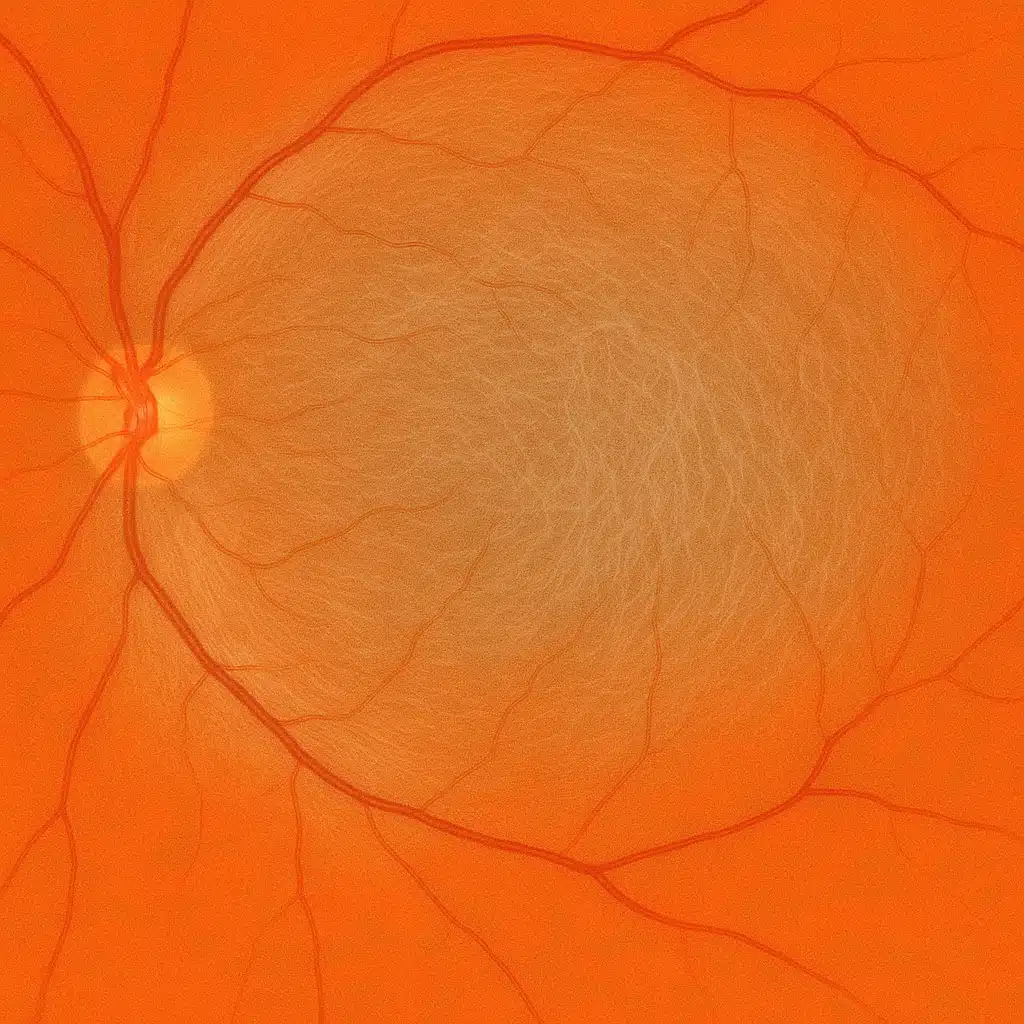

The macular epiretinal membrane is a thin film that forms on the surface of the macula, the central area of the retina responsible for fine vision. It can cause image distortion (metamorphopsia), progressive vision loss, and difficulty reading. It most commonly appears after age 50, in connection with natural changes in the vitreous. Dr Julien Gozlan, ophthalmic surgeon in Paris 16, explains the causes, symptoms, the role of OCT, and surgical treatment.
What is a macular epiretinal membrane?
The macular epiretinal membrane is a thin fibrous layer that develops on the inner surface of the retina, at the level of the macula. The macula is the most precise area of the retina: it enables reading, facial recognition, driving, and perception of fine details.
This epiretinal membrane can be compared to a transparent film laid over the retina. As it progressively contracts, it can "wrinkle" the macular layers and cause image distortion: straight lines become wavy, vision loses sharpness, and contrast decreases.
Why does an epiretinal membrane develop? Causes and risk factors
In many cases, no obvious cause is found: this is referred to as an idiopathic macular epiretinal membrane (or primary membrane). It is related to age-related changes in the vitreous, with micro-tractions that stimulate the formation of this tissue on the retinal surface.
A macular epiretinal membrane can also occur in other contexts:
- after a retinal disease: retinal detachment, diabetic retinopathy, retinal vein occlusion, uveitis, etc.
- after cataract surgery;
- after ocular trauma.
Age is the main risk factor: most membranes appear after age 50. High myopia, inflammation, and certain retinal conditions can increase the risk or accelerate progression.
Symptoms: how does a macular epiretinal membrane manifest?
Not all epiretinal membranes necessarily cause discomfort. Some remain asymptomatic for a long time and are discovered during a routine examination.
When the macular epiretinal membrane contracts and distorts the macula, the most common symptoms are:
- Progressive decrease in visual acuity at distance and/or near;
- Image distortion: wavy or broken lines (metamorphopsia);
- Difficulty reading: letters that seem to "move," faster fatigue;
- Blurred vision or a sensation of a central "spot";
- Sometimes double vision in one eye (monocular diplopia).
Symptoms are often more noticeable when reading, using a screen, or performing precision tasks. The discomfort may be moderate at first and then slowly increase over several months.
Diagnosis: how is a macular epiretinal membrane confirmed?
Fundus examination
Diagnosis begins with a fundus examination after pupil dilation. The physician may observe:
- A bright surface reflex (cellophane-like appearance);
- Folds or striae of the macular retina;
- Distortion or a "pulled" appearance of the small macular vessels.
Macular OCT: the key examination
The reference examination is macular OCT (optical coherence tomography). It is a retinal scan, completely painless, that provides very thin cross-sections of the macula.
It confirms the presence of the epiretinal membrane, measures its impact, and allows monitoring of progression over time. OCT also helps estimate the prognosis after surgery.
Typical OCT findings
OCT helps explain the symptoms and guide the decision. The most characteristic signs of a macular epiretinal membrane are:
- Hyperreflective line on the surface corresponding to the membrane;
- Surface folds and distortion of the vitreomacular interface;
- Loss of the foveal pit (flattened fovea);
- Macular thickening (sometimes significant);
- Intraretinal microcysts or tractional edema appearance;
- Disorganization of the inner layers in advanced forms;
- Analysis of the outer layers (particularly the external limiting membrane and ellipsoid zone) which influence visual gain after surgery.
These elements are essential: two patients may have a "similar" membrane on fundus examination, but very different levels of discomfort depending on the degree of macular distortion on OCT.
Is surgery always necessary for a macular epiretinal membrane?
Treatment is surgical, but it is not systematic. The goal is to operate at the right time, when the discomfort becomes truly disabling.
In practice, surgery is considered if:
- the visual discomfort is significant (reading, work, driving);
- there is a documented decrease in visual acuity;
- metamorphopsia is marked and bothersome;
- OCT shows significant traction or major macular distortion.
Conversely, a thin membrane that is minimally symptomatic and stable can simply be monitored with clinical follow-up and comparative OCT.
Decision criteria
The decision to operate on a macular epiretinal membrane does not rely solely on visual acuity measurement. The most useful criteria in practice are:
- Functional impact: slow reading, screen discomfort, visible distortion, difficulty driving;
- Progression: worsening of symptoms and/or OCT findings over several months;
- Status of the ellipsoid zone and outer layers (major prognostic criterion);
- Significant macular thickening and loss of the foveal pit;
- Ocular context: diabetes, high myopia, retinal history, inflammation.
The goal is to avoid operating too early on a minimally bothersome membrane, but also not to wait too long when the macula is severely distorted, at the risk of slower or incomplete recovery.
How is surgery for an epiretinal membrane performed?
Anaesthesia and preparation
The procedure is performed in the operating theatre under locoregional anaesthesia (eye numbed, patient awake) or general anaesthesia depending on the situation. Three micro-sclerotomy incisions of less than one millimetre allow instruments to be introduced.
Vitrectomy
The surgeon removes the vitreous by gentle suction (vitrectomy), providing direct access to the macula and allowing safe work on the retinal surface.
Membrane peeling
The epiretinal membrane is grasped with micro-forceps and carefully peeled from the retina. In some cases, the internal limiting membrane (the outermost layer of the retina) is also removed to reduce the risk of recurrence.
Closure
At the end of the procedure, the eye is filled with clear fluid. The micro-incisions are sealed, without sutures in the vast majority of cases.
Postoperative course and visual recovery
After the surgery, treatment with antibiotic and anti-inflammatory eye drops is prescribed. Redness, a gritty sensation, and light sensitivity are possible during the first few days.
Visual recovery is gradual. It often takes several weeks to several months to assess the final result, as the macula slowly "relaxes" after the traction is removed.
The goals of surgery are:
- Improve sharpness and contrast;
- Reduce distortions (metamorphopsia);
- Stabilize the condition long term.
Prognosis: what to realistically expect
The outcome depends primarily on:
- The duration of the membrane;
- The extent of macular distortion on OCT;
- The status of the outer layers (ellipsoid zone / external limiting membrane);
- Associated conditions (diabetes, high myopia, retinal history).
In many cases, the improvement is real but sometimes partial: vision becomes more comfortable and distortions decrease, without always returning to perfect. The functional benefit is often very noticeable for reading and screen work.
FAQ: frequently asked questions about macular epiretinal membrane
Is it an emergency?
In most cases, the macular epiretinal membrane progresses slowly and does not constitute an immediate emergency. However, the sudden onset or rapid worsening of vision loss or marked distortions (very wavy lines, sudden difficulty reading) should prompt a consultation without delay to check for any other associated macular condition.
Can a macular epiretinal membrane cause severe visual impairment?
When the membrane is thick and exerts significant traction on the macula, it can cause notable vision loss and bothersome distortions. However, even in advanced forms, peripheral vision is generally preserved. The goal of monitoring and, if necessary, surgery is to limit functional impairment in daily life (reading, screen work, precision activities).
Can a macular epiretinal membrane resolve spontaneously?
In practice, complete spontaneous regression is exceptional. The membrane tends to remain stable or thicken very gradually. In some patients, it remains minimally symptomatic for years and requires only regular clinical and OCT monitoring as long as vision remains comfortable.
Why do I see wavy or distorted lines?
The membrane acts like a contractile film laid over the macula. As it contracts, it "wrinkles" the retinal layers: the macular surface is no longer perfectly flat. The brain then receives a distorted image, which explains the wavy lines, letters that seem to "dance" or overlap, and sometimes a sensation of a blurry central spot.
Is the macular epiretinal membrane surgery painful?
The procedure is performed under regional or general anesthesia: the eye is numbed and the surgery is not felt. In the days that follow, superficial discomfort, a gritty sensation, or mild pain may occur, but these are generally well controlled with eye drops and standard pain medications.
How long does recovery take after the surgery?
Visual recovery after surgery is gradual. The first changes may be noticed within a few weeks, but the result often stabilizes between 3 and 6 months, sometimes longer. The speed and extent of improvement depend particularly on the duration of the membrane, the degree of initial distortion, and the condition of the outer retinal layers.
Can a macular epiretinal membrane recur after surgery?
Recurrence is possible but remains relatively rare, especially when the internal limiting membrane was peeled during the vitrectomy. If visual discomfort gradually reappears, a new macular OCT can verify the appearance of the retinal surface and, if needed, discuss further management.
What are the main risks of surgery?
As with any intraocular surgery, the procedure carries rare but possible risks: infection (endophthalmitis), bleeding, retinal detachment, increased intraocular pressure. In patients who have not yet had cataract surgery, vitrectomy can also accelerate the development of a cataract in the months or years that follow. These aspects are always explained in detail before the surgical decision.
Dr Julien Gozlan, ophthalmologist in Paris 16, performs a comprehensive macular assessment and discusses with you the surgical indication, expected benefits, and postoperative course.
📍 Consultation at the Paris – Auteuil Ophthalmology Practice
Dr Julien Gozlan welcomes you at the Paris – Auteuil Ophthalmology Practice for a comprehensive macular assessment, an OCT examination, and a personalized discussion about the value of surgery.
Book an AppointmentFurther reading
- Macular OCT: the reference examination for analyzing the macula.
- Vitrectomy: overview of vitreous and retinal surgery.
- Age-related macular degeneration (AMD): another common cause of macular disease.