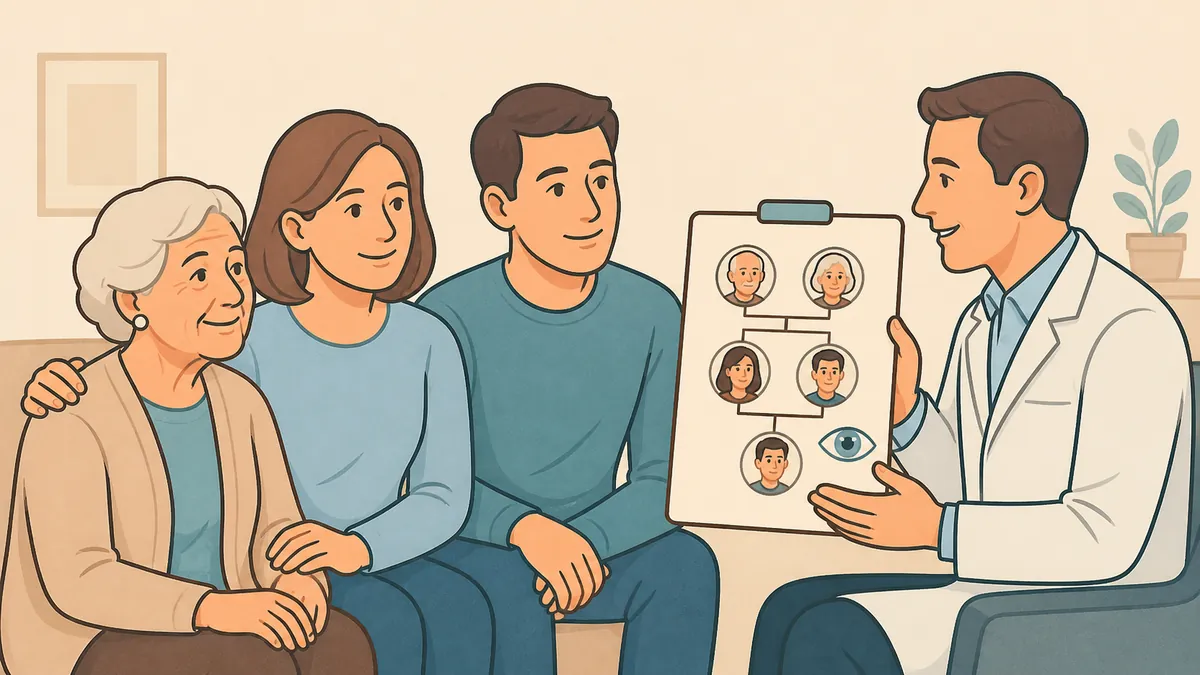

Hereditary AMD is one of the most common concerns raised during consultations: "my mother has AMD—will I get it too?" The term hereditary AMD is actually a shortcut, because the disease is not passed on like a simple genetic trait. Having an affected parent does genuinely increase the risk, but it is not inevitable. AMD is a multifactorial disease: genes matter, age matters, and the environment matters just as much. Here is what we know today, and above all what you can do in practical terms.
Hereditary AMD: what exactly are we talking about?
AMD (age-related macular degeneration) affects the macula, the area of the retina responsible for sharp central vision. When several members of the same family are affected, the condition is often referred to as hereditary AMD. In reality, what is passed on is not the disease itself but a predisposition. This genetic susceptibility only manifests when it encounters other factors: aging, smoking, diet, and sun exposure. That is the key difference from a classic genetic disease.
Does hereditary AMD truly exist?
No. A hereditary disease in the strict sense follows Mendelian inheritance: a single mutated gene is enough, and the risk of transmission can be calculated precisely from one generation to the next. This is the case for certain forms of retinitis pigmentosa, for example. AMD does not work that way. It results from the combined effect of many common genetic variations, each of small effect, together with age and lifestyle. No one "passes on" the disease to their children. At most, a degree of susceptibility is transmitted: it is in this sense, and this sense only, that the expression hereditary AMD should be understood.
What is the risk in the case of hereditary AMD?
The familial risk—what the term hereditary AMD concretely refers to—is real and well documented. Having an affected first-degree relative—father, mother, brother or sister—multiplies the risk compared with the general population: the order of magnitude is several-fold. But this finding must be properly understood:
- An increased risk is not a certainty: the majority of patients' children will never develop a severe form;
- The age of onset is not predetermined: you will not necessarily develop the disease at the same age as your parent;
- The form is not inherited: a mother with the wet form does not imply the same form in her children.
To understand all the factors involved, read our article on the causes of AMD.
The genes behind AMD: CFH and ARMS2/HTRA1
Research has identified two regions of the genome that are particularly involved: the complement factor H gene (CFH), which regulates inflammation, and the ARMS2/HTRA1 region. Carrying risk variants in these regions increases the likelihood of developing the disease. However, none of these variants is sufficient on its own: many carriers will never become ill, and some affected patients do not carry them. This is proof that genetics does not write the story alone: what we call hereditary AMD is a predisposition, not a sentence.
Should you get a genetic test for hereditary AMD?
No. Genetic testing for hereditary AMD is not recommended in routine clinical practice, and this point deserves a clear explanation:
- It does not change the monitoring strategy: your family history already justifies appropriate follow-up. A "high-risk" result adds nothing beyond information you already have;
- It does not change treatment: the management of established AMD is the same regardless of genetic profile;
- It does not predict an individual's future: a reassuring result guarantees nothing and does not exempt you from monitoring. It could even provide a false sense of security.
Outside research protocols, this test therefore has no place today.
Smoking and heredity: the most dangerous combination
Smoking is the most powerful modifiable risk factor for this disease. And it does not simply add to the genetic predisposition: it interacts with it. In a person carrying risk variants, smoking dramatically multiplies the likelihood of developing the disease. In other words, when there is a hereditary AMD predisposition, quitting smoking—or never starting—is the single most effective decision you can make for your eyes.
Hereditary AMD: how to reduce your risk?
When facing a hereditary AMD predisposition, you cannot choose your genes, but you can act on everything else:
- Do not smoke: this is the number-one measure, with no equivalent;
- Eat a healthy diet: green leafy vegetables, oily fish, and a variety of fruits and vegetables;
- Protect your eyes from the sun: quality sunglasses in cases of strong exposure;
- Control your weight and blood pressure: vascular health also matters for the retina.
Hereditary AMD: what monitoring is needed when a parent is affected?
In the case of hereditary AMD—that is, a family history of the disease—the practical approach is straightforward. Plan a baseline fundus examination around the age of 50–55, or earlier if a symptom appears: decreased vision, wavy straight lines, or a central spot. The monitoring frequency is then tailored by your ophthalmologist. An OCT scan often complements the examination to analyze the macula in detail. Also learn to use the Amsler grid: this simple test, performed at home one eye at a time, helps detect line distortion at an early stage.
FAQ: Hereditary AMD
My mother has AMD: will I necessarily get it?
No. Your risk is higher than that of the general population, but most children of patients will never develop a severe form. Hereditary AMD refers to a predisposition, not a destiny.
At what age should I have a first fundus exam?
Around age 50–55 in the absence of symptoms, to have a baseline examination. Earlier if you notice decreased vision, distorted lines, or a spot in the center of your visual field.
Is genetic testing useful in cases of hereditary AMD?
No, it is not recommended in routine practice. It does not change monitoring or treatment, and its results cannot individually predict who will develop the disease.
Hereditary AMD: will I pass it on to my children?
You do not pass on the disease itself, but possibly a degree of predisposition. Your children will benefit from the same advice as you: no smoking, a healthy lifestyle, and a fundus exam around age 50–55.
What can I do now to reduce my risk?
Do not smoke, eat green vegetables and fish, protect your eyes from the sun, watch your weight and blood pressure. And consult promptly if you experience any new visual symptoms.
When should you see Dr Julien Gozlan?
If one of your parents has AMD, a screening consultation gives you a clear picture: fundus examination, OCT angiography if needed, and personalized prevention advice. Consult promptly if you experience distorted lines, a central spot, or decreased vision. Dr Julien Gozlan, an ophthalmic surgeon specializing in retinal conditions in Paris 16, provides this screening and follow-up for patients with a hereditary AMD predisposition.
📍 Consultation at Cabinet Ophtalmologique Paris - Auteuil
Dr Julien Gozlan welcomes patients at Cabinet Ophtalmologique Paris - Auteuil for an AMD screening assessment in cases of family history: fundus examination, macular imaging, and prevention advice tailored to your situation.
Book an appointmentFurther reading
- AMD: understanding the disease, its dry and wet forms;
- Causes of AMD: all the risk factors in detail;
- The Amsler grid: the self-monitoring test you should know;
- AMD and OCT angiography: modern macular imaging;
- Intravitreal injections: treatment for wet forms.