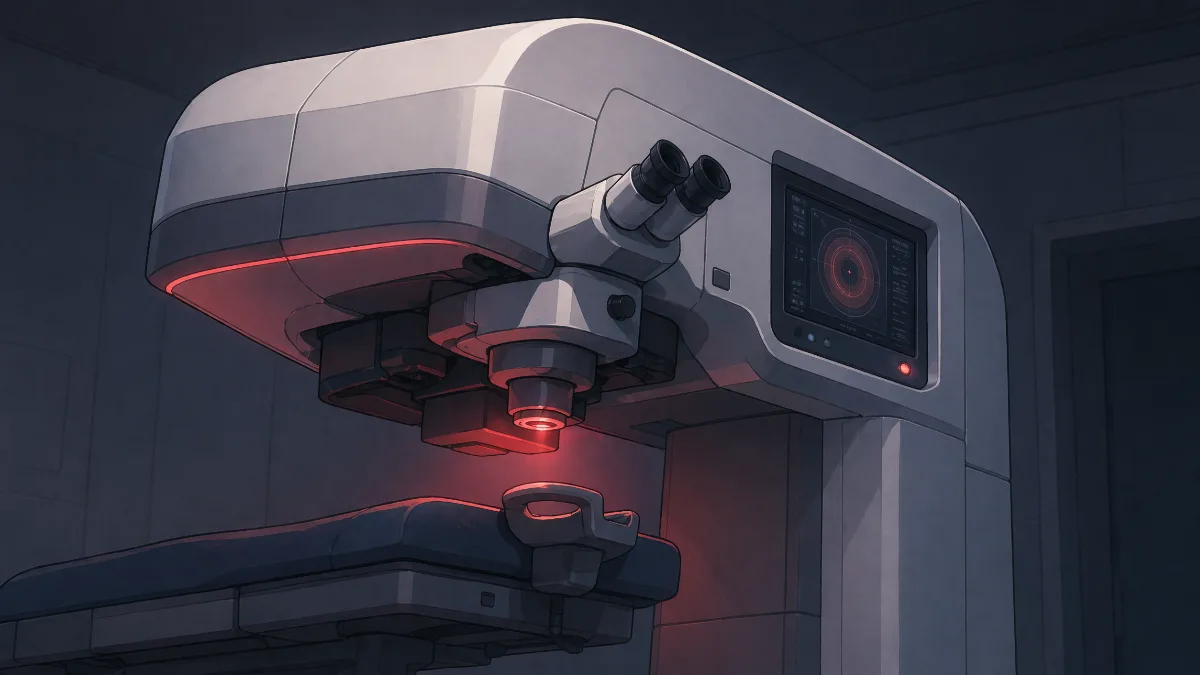
Femtosecond laser cataract surgery raises many questions among patients considering lens surgery. Presented as a major technological advancement, the femtosecond laser applied to cataract surgery is the subject of intensive marketing, but the international scientific literature reveals specific limitations and risks compared to conventional manual phacoemulsification. Dr Julien Gozlan, ophthalmologist in Paris 16, explains why the manual technique remains the safest and most reproducible standard for cataract surgery.
Femtosecond laser cataract surgery: principle and steps of the technique
The femtosecond laser is an ultra-short pulse laser (on the order of a femtosecond, i.e., 10⁻¹⁵ seconds) capable of cutting ocular tissues with great theoretical precision. When we refer to femtosecond laser cataract surgery, it involves using this laser to assist several steps of cataract surgery:
- Corneal incisions: main incision and side-port incisions, usually performed with a calibrated keratome.
- Capsulorhexis (anterior capsulotomy): circular opening of the anterior capsule of the lens, a critical step of the procedure.
- Lens nucleus fragmentation: pre-cutting of the opacified lens to facilitate its subsequent aspiration by phacoemulsification.
- Arcuate relaxing incisions: corneal incisions intended to correct preoperative astigmatism.
On the surface, the combination of femtosecond laser cataract surgery appears appealing. However, the international scientific literature, accumulated over more than a decade, reveals specific limitations and risks that warrant particular attention before choosing this approach.
Specific risks and complications associated with femtosecond laser cataract surgery
Capsular tears and capsulorhexis irregularities
Femtosecond laser-assisted capsulorhexis produces a so-called "perfectly circular" capsulotomy. However, several studies published in leading journals (Journal of Cataract & Refractive Surgery, Ophthalmology) have demonstrated that this laser cutting generates serrated capsular edges, with micro-bridges and irregularities at the microscopic level. These imperfections create points of weakness that may cause a radial capsular tear during lens manipulation or intraocular lens insertion. The study by Abell et al. (2014) reported a significantly higher rate of anterior capsular ruptures in the group receiving femtosecond laser cataract treatment compared to manual capsulorhexis. An experienced surgeon performing conventional phacoemulsification creates a continuous curvilinear capsulorhexis with smooth, elastic edges, offering superior mechanical resistance.
Poorly calibrated corneal incisions
Corneal incisions performed with the femtosecond laser during femtosecond laser cataract surgery present irregular walls at the tissue level, with a "crenellated" appearance related to the photodisruption mechanism. Several publications have highlighted an increased risk of poor wound sealing with these incisions compared to manual incisions made with a calibrated keratome, potentially increasing the risk of postoperative endophthalmitis. Furthermore, the multi-plane (tri-planar) architecture mastered by the surgeon using a keratome is more difficult to reproduce with the laser, sometimes compromising the self-sealing properties of the incision.
Intraoperative miosis and increased inflammation
Application of the femtosecond laser prior to phacoemulsification causes a release of prostaglandins into the anterior chamber, leading to intraoperative miosis (pupillary constriction). This phenomenon, well documented by Schultz et al. (2013) and Nagy et al. (2014), considerably complicates the remainder of the procedure: reduced visibility, more difficult maneuvers, and increased risk of iris trauma and posterior capsular rupture. This problem, specific to the femtosecond laser cataract technique, simply does not exist in standard manual phacoemulsification performed with precise preoperative ocular biometry.
Suction loss and incomplete docking
The interface between the laser and the patient's eye (docking system using a suction ring or liquid interface) can result in suction loss during the procedure. This incident requires either restarting the laser cutting—with the risk of imprecise overlap of impacts—or converting to manual technique under degraded conditions. Cases of capsular block related to gas penetration into the posterior chamber, described by Roberts et al. (2011), represent a complication unique to femtosecond laser cataract surgery with no equivalent in the conventional technique.
Femtosecond laser cataract surgery versus manual phacoemulsification: what the science says
Several large-scale meta-analyses, notably the Cochrane review (Day et al., 2016; updated by Narayan et al., 2023, covering 42 trials and 7,298 eyes), converge on the same conclusion: femtosecond laser cataract surgery provides no significant clinical benefit over manual phacoemulsification in terms of postoperative visual acuity, rate of serious complications, or final refractive outcome. The FEMCAT study, a French multicenter randomized trial, reached the same conclusions: no demonstrated superiority of the femtosecond laser for cataract surgery, at a considerable additional cost.
Conversely, the manual phacoemulsification technique, refined over more than fifty years, offers the surgeon unparalleled intraoperative adaptability. When faced with a brunescent lens, a narrow pupil, a shallow anterior chamber, or a fragile zonule, the experienced surgeon adjusts each maneuver in real time. This flexibility is lacking with the femtosecond laser, whose parameters are programmed before the procedure based on preoperative imaging, which constitutes a fundamental limitation in the debate over femtosecond laser cataract surgery.
Conventional phacoemulsification: a proven technique for cataract treatment
Cataract surgery by manual phacoemulsification is today the most commonly performed surgical procedure in the world, with over 800,000 procedures per year in France. Its rate of serious complications (posterior capsular rupture, endophthalmitis) is less than 1% in the hands of a trained operator. Dr Julien Gozlan performs this procedure daily using phacoemulsification with implantation of latest-generation lenses—multifocal, EDOF, or toric—selected through high-precision optical biometry.
The advantages of the manual technique over femtosecond laser cataract surgery are numerous: reduced operative time, no additional cost related to the laser platform, no induced miosis, capsulorhexis with smooth and resistant edges, well-controlled self-sealing incisions, and above all an ability to adapt immediately to any unforeseen anatomical situation. For patients with associated retinal pathologies—AMD, epiretinal membrane, diabetic retinopathy—this comprehensive surgical expertise is all the more essential.
Femtosecond laser cataract surgery: a marketing argument rather than a medical one?
It must be stated clearly: the use of the femtosecond laser in cataract surgery is more of a marketing argument than a demonstrated medical advancement. The cost of the laser platform (approximately 500,000 euros, plus expensive consumables) generates an additional cost billed to the patient, with no proven benefit on visual outcome. International scientific societies, including the ESCRS (European Society of Cataract and Refractive Surgeons), have never recommended the femtosecond laser as a standard of care. The topic of femtosecond laser cataract surgery remains a subject of debate at specialized conferences, but the data converge toward the absence of clinical superiority.
Ultimately, the best guarantee of success for a cataract operation lies in the surgeon's experience, the quality of the preoperative assessment including OCT and biometry, and the judicious choice of the implant—not in the use of a laser technology whose benefits remain to be demonstrated. In the face of claims about femtosecond laser cataract surgery, it is essential to prioritize scientific evidence over the allure of technological novelty.
FAQ: femtosecond laser cataract surgery
Is the femtosecond laser safer than manual phacoemulsification for cataract surgery?
No. High-level evidence scientific studies, including Cochrane meta-analyses, show that femtosecond laser cataract surgery does not reduce the complication rate compared to manual phacoemulsification. Certain complications are specific to it — intraoperative miosis, and capsulorhexis tear-out reported in some series — even though pooled randomized trials do not find an excess risk of capsular tear.
Why is the femtosecond laser presented as an advancement in cataract surgery?
The femtosecond laser benefits from significant marketing by equipment manufacturers. Its high-technology image reassures patients. However, international scientific societies do not recommend femtosecond laser cataract surgery as a standard of care, due to the lack of demonstrated clinical benefit compared to the manual technique.
Is cataract surgery by phacoemulsification painful?
The procedure is performed under local anesthesia (anesthetic eye drops) and takes approximately 10 to 15 minutes. It is painless in the vast majority of cases. Postoperative recovery is generally straightforward, with rapid visual recovery within the first few days.
When can driving be resumed after cataract surgery?
Driving can generally be resumed within 48 to 72 hours after the procedure, provided that sufficient visual acuity is confirmed at the postoperative follow-up appointment. Dr Julien Gozlan will provide you with personalized guidance during follow-up.
Is the additional cost of femtosecond laser cataract surgery justified?
The additional cost associated with the femtosecond laser cataract technique, often amounting to several hundred euros per eye, is not justified by current scientific data. No study has demonstrated a better visual outcome or a lower complication rate with the femtosecond laser compared to manual phacoemulsification performed by an experienced surgeon.
What are the risks specific to the femtosecond laser during cataract surgery?
The specific risks of femtosecond laser cataract surgery include capsular tear of the capsulorhexis (radial capsular tear), intraoperative miosis related to prostaglandin release, suction loss during docking, irregular corneal incisions, and capsular block due to gas migration. These complications are absent from the conventional manual technique.
When to consult Dr Julien Gozlan?
If you are experiencing a gradual decline in vision, a sensation of haze, increased glare, or growing difficulty driving at night, these symptoms may suggest a cataract requiring a comprehensive ophthalmological assessment. Dr Julien Gozlan welcomes you for a thorough examination including visual acuity measurement, slit-lamp examination, OCT, and ocular biometry, in order to determine the optimal timing for surgery and to offer you the most appropriate and safest surgical technique—manual phacoemulsification with a latest-generation lens implant. Beyond the debate over femtosecond laser cataract surgery, it is the surgeon's expertise that ensures the best visual outcome.
📍 Consultation at the Paris – Auteuil Ophthalmology Practice
Dr Julien Gozlan welcomes you at the Paris – Auteuil Ophthalmology Practice for a comprehensive assessment of your cataract and supports you at every stage, from diagnosis to phacoemulsification surgery. An experienced surgeon, he favors a proven manual technique, ensuring safety and optimal visual outcomes.
Book an Appointment on DoctolibFurther reading
- Cataract surgery: procedure and recovery: everything you need to know about the steps of phacoemulsification surgery and visual recovery.
- Ocular biometry: understanding this essential examination for calculating the intraocular lens implant before surgery.
- AMD: diagnosis and treatments: causes, symptoms, and management of age-related macular degeneration.
- OCT: optical coherence tomography: the role of this imaging examination in the preoperative cataract assessment and retinal follow-up.